In my previous blog, the first in a short series, I set out some background to the process of curriculum making and instructional design. In this next instalment I will describe a significant piece of research-informed curriculum and instructional design I undertook relatively early in my career in the early 1990s. I think lessons can be drawn from this that are instructive for those undertaking similar work today.
The problem
In the late 1980s and early 1990s in what was then Grampian Regional Council, with the encouragement of the science advisor, many schools adopted the Science in Process resources for their S1/2 (ages 12-14) science course (Science in Process | Resource Collection, no date). These were developed in ILEA, the Inner London Education Authority, and published by Heinemann. Science in Process, as the name suggests, focussed predominantly of teaching science processes and methods and the units and lessons were themed on broad contexts. I was responsible for introducing the course as an Assistant Principal Teacher in one school but before this was completed got promoted to Principal Teacher in a second which was then just beginning to introduce Science in Process. I therefore got a second go to try and get the implementation right.
What became obviously quite quickly, certainly within a couple of years or so, was that the pupils were not learning as much as hoped for as they worked through the materials. The focus on processes and skills was not allowing the pupils to build up a background of subject knowledge in a sufficiently coherent and systematic manner. There was too much focus on ‘knowing how’ rather than ‘knowing that’ as described by Rata’s Curriculum Design Coherence Model (Rata, 2024). This lack of basic subject knowledge then became a barrier to them developing the capacity to apply the skills they were supposedly learning. With hindsight, this was a classic example of an overly skills-based curriculum. The pupils were often busy in class but not learning productively and at times becoming frustrated by having to struggle to do activities for which they were not adequately prepared with the relevant background subject knowledge. Those who came with good cultural capital from home coped alright, but we were not providing adequate support for those who did not. Again, with hindsight, it is perhaps not surprising that this was the outcome for a course produced in ILEA in the 1980s as it was an organisation committed to championing a ‘progressive’ approach to education.
Collectively, the science teachers in the school decided there must be something better.
An alternative approach
From 1983 and 1990, Rosalind Driver led the Children’s Learning in Science (CLIS) Project at the University of Leeds. Ros Driver led a substantial science education research group and conducted much of the seminal research into children’s ideas in science helping identify many of the common misconceptions children have about science ideas.
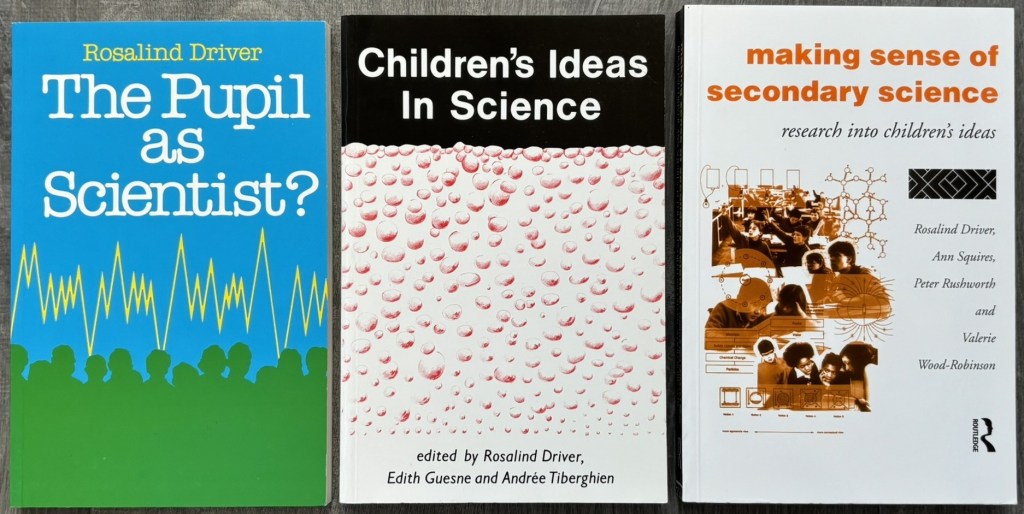
Figure 1: Seminal texts by Ros Driver and colleagues (Driver, 1983; Driver, Guesne and Tiberghien, 1985; Driver et al., 1994)
The CLIS Project built on the research into children’s ideas and developed and tested in school resources to teach several topics in science. They published several booklets, handbooks and case studies detailing the approach and their findings. One of the topics was on the particle theory of matter. I first became properly aware of the research and resources by attending a talk given by Phil Scott, one of Ros Driver’s team, at an Association for Science Education (ASE) Annual Conference in England. Shortly after, I was on the organising committee for the ASE Scotland Annual Conference to be held in Culloden. I persuaded the others on the committee to bring Phil up from Leeds as one of the keynote speakers. I attended this talk along with one of my colleagues and we returned to our school enthused to persuade our department to use the CLIS approach to develop a unit of work on matter for the revised S1/2 course we were developing.
The particle theory of matter is widely seen as one of the ‘Big Ideas’ in the sciences. It is listed as the first subject matter ‘Big Idea’ in The Principles and Big Ideas of Science Education (Harlen, 2010) and The Fundamentals of 11-19 Physics (Institute of Physics, 2024). Richard Feynman, one of the greatest physicists of the 20th century, said:
“If in some cataclysm, all of scientific knowledge were to be destroyed, and only one sentence passed on to the next generation of creatures, what statement would contain the most information in the fewest words? I believe it is the atomic hypothesis that all things are made of atoms – little particles that move around in perpetual motion, attracting each other when they are a little distance apart, but repelling upon being squeezed into one another. In that one sentence, you will see there is an enormous amount of information about the world, if just a little imagination and thinking are applied.” (Feynman, Leighton and Sands, 1963)
I think it is safe to say, that knowledge of the particle theory of matter is widely seen as being a core part of lower secondary science courses. An understanding that matter is made up of particles underpins pretty much all of chemistry and many physics topics such as electricity, radioactivity, kinetic theory, and quantum physics. We were keen to ensure that our S1/2 pupils received a good grounding and basic understanding of the ideas involved.
Using the CLIS particle theory of matter resources we developed a Matter unit, which sat alongside other more traditionally designed units such as Electricity, Energy, and Heat covering content not dissimilar to the units from Curriculum Paper 7 (Scottish Education Department Consultative Committee on the Curriculum, 1969) which had shaped the science curricula of Scottish secondary schools through the 1970s and 1980s plus a unit on Electronics using Microelectronics For All (MFA) boards and resources.
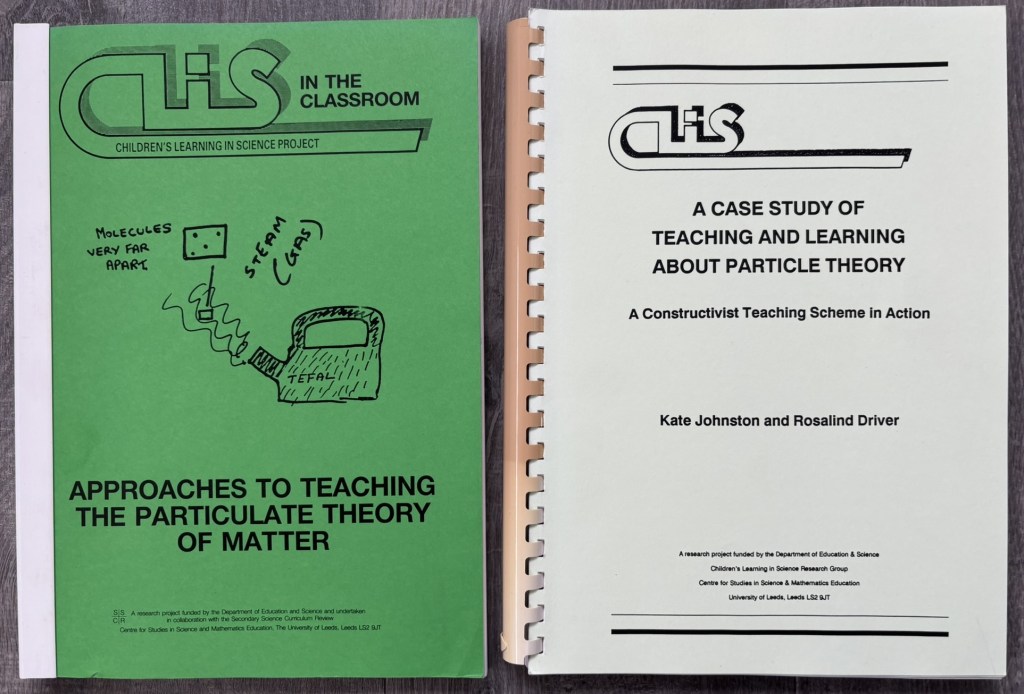
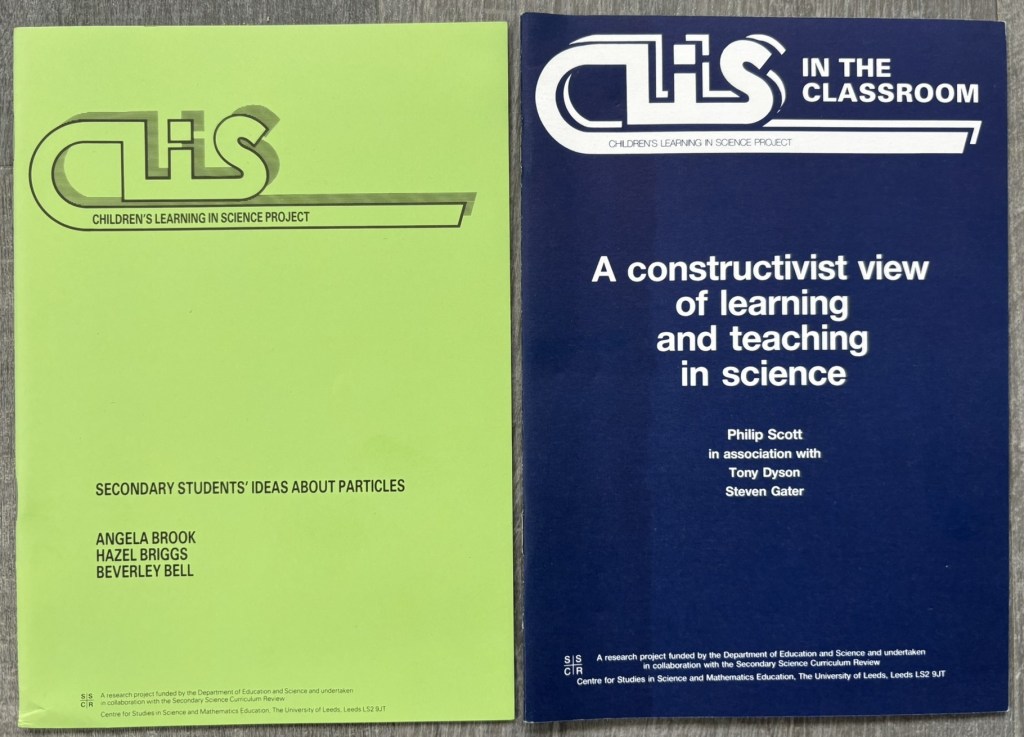
Figure 2: CLIS particle theory of matter resources
The Matter unit guided pupils through a series of activities which presented different objects and scenarios illustrating solids, liquids and gases and their behaviours. For example, pupils had to squeeze three sealed syringes, one containing air, one containing water, and one containing sand, and then record their observations (the air could be compressed but the water and sand could not). The carefully constructed and guided sequence was designed to allow the pupils to build up knowledge based on the constructivist learning theory which underpinned CLIS. Other activities were designed to create cognitive conflict and thereby develop pupils’ understanding. For example, when looking at whether objects had a fixed shape or volume, after encountering examples such as rocks or blocks of wood and metal the pupil were presented with a piece of sponge. A sponge cannot be easily classified as a solid, liquid or gas as it has a solid structure around voids of air making it something that at first glance might be considered a solid but which neither has a fixed shape or volume when squeezed.
Some observations and conclusions
Looking back now, I can see that the sequence of activities was not just a random assortment, not that I ever thought that they were, but exhibited many of the characteristics of Zig Engelmann’s approach to the use of examples and non-examples to establish an understanding of an idea. By working through a carefully considered and structured sequence of examples and non-examples designed to illustrate ‘sameness’, the pupils should be able to identify the generalised idea or concept. For a good simple account of the use of examples and non-examples see chapters 4 and 5 in Tom Needham’s book Engelmann’s Direct Instruction in Action (Needham, 2026).
Also looking back now, it is clear that the CLIS materials were very strongly based on constructivist theory of learning principles which had gathered significant momentum during the 1980s, certainly within science education. The materials were designed to allow the pupils to construct their own understanding by working through a series of activities rather than to learn what they were told using a more transmissive teaching approach. A significant amount of research and evaluation had been done with the schools which had field tested the draft materials, something that they also had in common with Engelmann’s approach to resource development. This iterative process had helped hone a good set of resources.
The Science in Process resources also claimed to draw on CLIS evidence, however, I suspect that their development did not go through the same quality of iterative evaluation and refinement as the CLIS teaching materials. I suspect the materials were also more ideologically driven and were subject to a problem I have observed with constructivism elsewhere. Constructivism is a theory of learning. Everyone constructs meaning by building new knowledge on that which they already have, the schemas in their long-term memory. As David Ausubel said:
“The most important single factor influencing learning is what the learner already knows. Ascertain this and teach him (sic) accordingly.” (Ausubel, 1968)
The CLIS materials make this statement about the learning process:
“A constructivist view of learning perceives students as active learners who come to science lessons already holding ideas about natural phenomena, which they use to make sense of everyday experiences. Learning science, therefore, involves students in not only adopting new ideas, but also in modifying and abandoning their pre-existing ones. Such a process is one in which learners actively make sense of the world by constructing meanings.” (Scott, Dyson and Gater, 1987, p7)
This acknowledges every pupil enters a classroom with knowledge, but this will be different for every pupil. Later in the same booklet, it says of the teacher:
“From a constructivist perspective, the role of the teacher is modified. No longer does the teacher play the part of ‘purveyor of knowledge’. The teacher’s role becomes on of diagnostician, prescriber of appropriate learning activities and facilitator of learning. … Of course, the teacher is still in charge but greater responsibility is given to the pupils.” (Scott, Dyson and Gater, 1987, p16)
This statement is consistent with that of Ausubel but highlights the complexity of teaching if pupils arrive in any particular classroom with a very varied range of prior knowledge. In the statement about the teacher, I also think one can see where the constructivist approach often started to go wrong. The teacher’s role in the CLIS particle theory of matter materials was indeed a diagnostician and facilitator of learning but using resources that had been well designed, field tested and improved by expert teachers, teacher educators and education researchers. For any teacher to then use them well they had to be deeply familiar with their purpose and design, so they could readily diagnose difficulties and intervene and support struggling pupils accordingly. If this was not the case, their ability to diagnose and intervene accordingly would be poor.
Constructivism is not a theory of teaching, it does not state that teachers should stand back and allow pupils to reach conclusions without significant teacher input and direction of pupils’ learning, whether that be through well designed guided enquiry resources or more explicit direct teaching, but I think that is where the Science in Process resources had veered. This scenario left pupils having to work too much out for themselves with inadequately designed resources and insufficient teacher led explicit instruction to help ensure that the pupils built up coherent schemas connecting the various bits of knowledge together. That constructivism said that pupils learn by constructing their own knowledge became increasingly interpreted in the years since CLIS that teachers should step back and allow pupils to work things out for themselves in what has often been referred to as a ‘child-centred’ rather than a ‘teacher-led’ manner. The irony of taking such an approach, is that I suspect that for many of the pupils this made the science appear to be a disconnected collection of facts rather than allow the pupils to get an authentic experience of ‘doing science’ and to find the ‘big ideas’ of science as the authors of the resources had intended. I do not think that is what a constructivist approach implies. I think it is the role of the teacher to ensure that the content of the curriculum and the instructional materials used, guide the pupils through their lessons in a way that the teacher can be confident that they have the best opportunity to build coherent schema in their long-term memories. That cannot be left to chance and requires active and explicit teaching by a teacher knowledgeable in the subject matter alongside well designed individual and group activities for the pupils
Other than our own professional judgement, the only data we gathered about the success of the CLIS inspired Matter unit were from the end of unit tests we wrote ourselves to gather information for reporting etc. Certainly, there was more satisfaction with our revised S1/2 science course than with Science in Process. In an ideal world, with time and resources to allow for it, it would have been good to have gathered more robust data, iteratively improve the resources over time, and to be able to compare our approach with others. Any new initiative, thanks to the effort and enthusiasm of its developers, and the time invested in it, is likely to see some benefits and improved pupil outcomes. To minimise this potential placebo effect, for all curriculum-making and instructional design initiatives, I would like to see proper evaluation with robust assessment of pupils outcomes where the initiatives are compared not just with appropriate control groups but with other similar parallel initiatives to see which was best. The largest research project of this type was Project Follow Through in the 1960s and 1970s (NIFDI, 2024), but smaller scale comparative projects would still be very valuable in helping identify best practice. Unfortunately, I moved schools again shortly after we introduced the new course and the organisation of the science departments in my new school did not allow me to continue with this type of Matter unit, and I am sure my previous school moved on too, but I still reflect back on the work we did to try and build a research informed unit based on the CLIS materials with some fondness and disappointment I could not have taken it further.
It would be good if our education system could properly facilitate systematic and long-term educational research into different approaches to curriculum making and instructional design. This would require better funding for educational research groups in our universities; within education faculties and disciplinary areas. It would also require that teachers could be afforded the time, space and support to undertake and participate in such work as a normal part of their job. Opportunities for teachers to interact with researchers, such as the opportunities that the ASE Annual Conferences offered me, are needed together with effective means to disseminate findings so that good practice could then be better enacted across the system. It would also need consistent and objective assessment of pupil outcomes so that the impact of initiatives could be more reliably determined where it matters, i.e., the learning and attainment of pupils. None of this is necessarily difficult but it requires some prioritisation and funding, but perhaps most importantly, recognition that this is necessary if teaching is to become a true profession.
With the hindsight and further learning that 30 years brings, I am no longer so convinced that the CLIS approach was necessarily an efficient way to teach the intended knowledge about matter, but I certainly think that when done well it was effective at developing understanding of some of the most important but abstract concepts in science. I am sure that both Ros Driver and Phil Scott would have both gone on to make other substantial contributions to physics education research (PER) if they had both not unfortunately succumbed to cancer at relatively young ages.
Prompted by the Curriculum Improvement Cycle, which began in 2024, together with my research into science curricula internationally, including my visit to Aotearoa New Zealand in the autumn of 2025, I have returned to the particle theory of matter and how it should be included in the policy and programmatic curriculum nationally as well as how teachers might take this and make their own classroom curriculum and design appropriate instructional resources. I will discuss what can be learned from consideration of curricula from other jurisdictions in the next blog in this short series.
References
Ausubel, D. (1968) Educational Psychology: A Cognitive View. Holt, Rinehart & Winston.
Driver, R. (1983) The pupil as scientist? Buckingham: Open University Press.
Driver, R. et al. (1994) Making Sense of Secondary Science: Research into children’s ideas. London: Routledge.
Driver, R., Guesne, E. and Tiberghien, A. (eds) (1985) Children’s Ideas In Science. Milton Keynes: Open University Press.
Feynman, R., Leighton, R. and Sands, M. (1963) The Feynman Lectures on Physics; Volume 1. Pearson Education.
Harlen, W. (2010) Principles and big ideas of science education, Association for Science Education. Hatfield: Association for Science Education. Available at: https://www.ase.org.uk/bigideas.
Institute of Physics (2024) The fundamentals of 11 to 19 physics | Institute of Physics. Available at: https://www.iop.org/about/publications/fundamentals-11-19-physics.
Needham, T. (2026) Engelmann’s Direct Instruction in Action. London: Hachette Learning.
NIFDI (2024) Project Follow Through. Available at: https://www.nifdi.org/what-is-di/project-follow-through.html.
Rata, E. (2024) ‘The Curriculum Design Coherence Model’, Research Handbook on Curriculum and Education, pp. 261–279. doi: 10.4337/9781802208542.00025.
Science in Process | Resource Collection (no date). Available at: https://www.stem.org.uk/resources/library/collection/3611/science-in-process.
Scott, P., Dyson, T. and Gater, S. (1987) A constructivist view of learning and teaching in science. Leeds: Centre for Studies in Science and Mathematics Education, The University of Leeds.
Scottish Education Department Consultative Committee on the Curriculum (1969) Curriculum Paper 7 – Science for General Education: for the first two years and the early school leaver. Edinburgh: HMSO.


Leave a Reply