So far in this series of blogs, I have discussed some theoretical frameworks and then, using the properties of matter strand of physics looked at how the policy and programmatic curricula in a jurisdiction could be set out to support effective classroom curriculum making by teachers and groups of teachers working collaboratively.
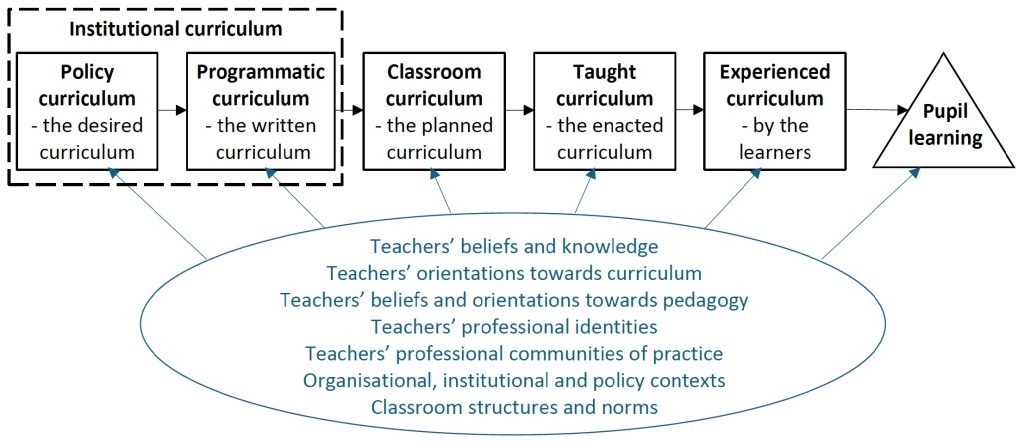
Figure 1: The stages of curriculum making adapted from (Deng, 2020) and (Surma et al., 2025)
However, when it comes to classroom curriculum making and the taught curriculum delivered in the classroom this is tightly bound up with instructional decision-making and instructional design.
“The enacted curriculum cannot be disentangled from pedagogy.” (Priestley et al., 2025, p14)
When deciding ‘what’ to teach I think it is inevitable that teachers conflate this with the ‘how’ to teach it. The ‘how’ to teach it then involves considerations about what explanations to use, what questions to ask, what activities to use, what resources to use or are perhaps just available, how to assess what is taught, and in subjects such as physics whether practical activities are teacher-led demonstrations or paired or small group pupil activities. All these questions, and more, are often melded together simultaneously.
It was thinking about this issue, and how to improve the process at scale across the education system, that initially prompted me to start thinking about writing this series of blogs, and the working title was ‘empirically based curriculum making’. However, I quickly realised that to do this justice I needed to cover other issues too, and that grew to the four blogs already published. Local curriculum making and the related instructional design is hugely hampered if teachers do not have a strong institutional curriculum from which to build. I arrived at the term ‘empirically based curriculum making’ due to my consideration of the iterative design and improvement of a unit on teaching optics that I heard Claudia Haagen-Schützenhöfer describe at a conference in 2017 (Haagen-Schützenhöfer and Hopf, 2020). That the process began with the findings from research into children’s ideas and misconceptions about the physics involved reminded me of the development of the unit on teaching about matter I described in second blog in this series. However, what most interested me then and now was the process they had used which was research-informed, both long-term and iterative, and used a large data set of multiple forms of evidence. I referred to this project in a previous series of blogs two years ago. When I started to read into the work of Zig Engelmann (Engelmann, 2007) and the processes which led to his Direct Instruction programmes I began to see parallels in the two processes.
Design-based research to develop a teaching and learning environment
The idea of using repeated research and development cycles to improve a product is certainly not new, but how Haagen-Schützenhöfer and Hopf model the research and development process for the development of a teaching and learning environment (TLE), i.e., a classroom curriculum and the associated instructional resources for a unit of work, is shown in figure 2.
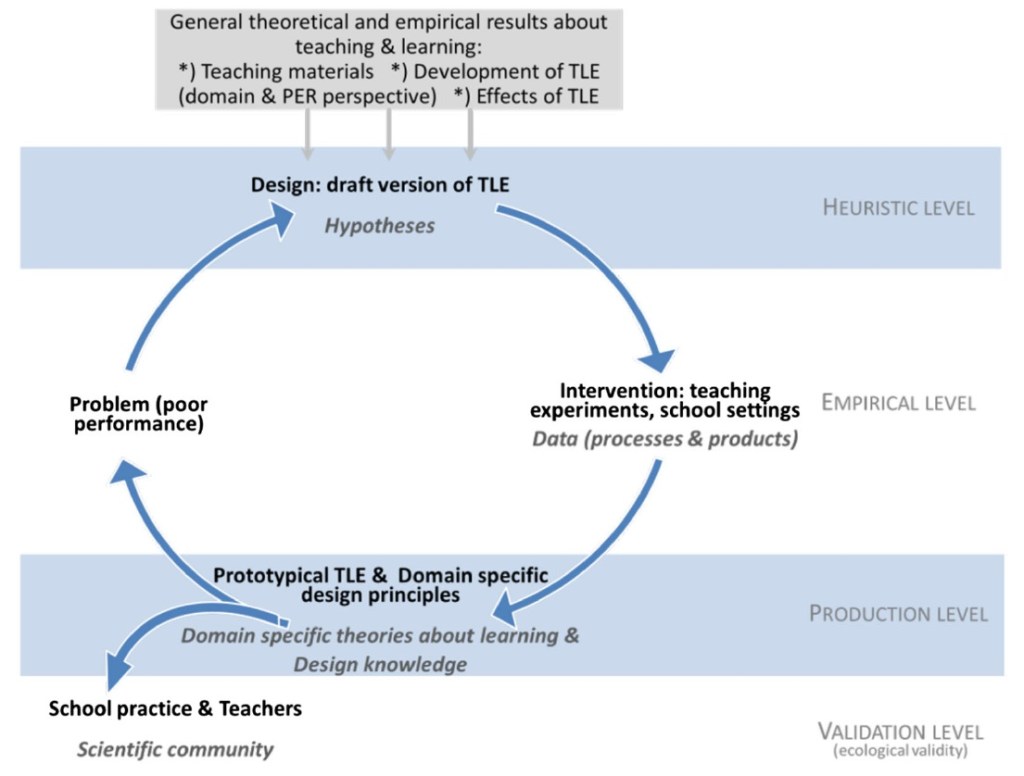
Figure 2: A model of a design-based research process for the development of a teaching and learning environment (TLE). Successive stages of the development process are shown in bold and the related research process in italics (Haagen-Schützenhöfer and Hopf, 2020, p8).
How the process shown in figure 2 was applied to the development of a unit for teaching geometiric optics to lower secondary pupils is shown in figure 3.
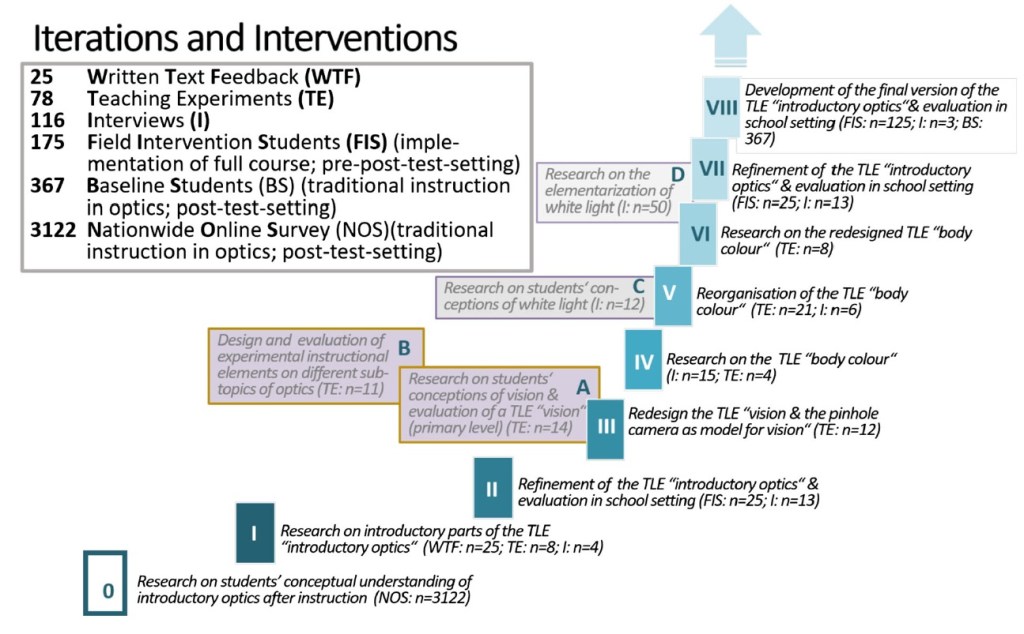
Figure 3: The design cycles and interventions in the design process for a unit on geometrical optics for lower secondary pupils (Haagen-Schützenhöfer and Hopf, 2020, p9).
Figure 3 shows how findings from research into children’s understanding of optics concepts can be used to inform the development of instructional resources and strategies which are field tested and then iteratively improved as a result of teacher feedback and pre- and post-test data from pupils. To hone a unit of work this design-based research cycle could be gone through several times. An important part of this process is the availability of high-quality objective assessment instruments to determine pupil outcomes. These could be developed on a case-by-case basis for each design project, but it would be good if we could have such assessment instruments available to allow the reliable comparison of different approaches to the teaching of the same topics. Examples of such assessment instruments have been developed for the assessment of physics at upper secondary and undergraduate level, for example, the Force Concept Inventory (Hestenes et al., no date). Whilst it is dangerous to try and conflate too many purposes into a single assessment instrument, the absence of any systematic and robust assessments in the broad general education (BGE – ages 3-15) phase in Scottish education makes comparison of outcomes all but impossible. This, along with the vague curriculum statements, means that much teacher time has been wasted attempting to ‘moderate’ the assessment of something that is barely a thing in the first place.
Assessing impact
I have increasing come to the view that the advantages of having some form of national testing arrangement outweigh the disadvantages. We need objective measures of success. Such an approach does require a qualification in-so-far as it is important that the design and quality of these are high and that they are used in a way which does not promote a ‘teaching to the test’ mentality which only ever results in unwelcome performativity. Teaching to the test can be mitigated by testing being conducted on a sample basis as a measure of the quality of the education system, just as the PISA and TIMSS international tests are used, but relevant assessments could also be used to help compare the relative outcomes and merits of curriculum and instructional resources projects. Separate formative and diagnostic assessments could be used on an ongoing basis by teachers to support the learning of pupils. Collaborative, co-ordinated generation of assessment items would help reduce teacher workload as well as give consistency across the system.
A separate argument for this form of national testing is that I do not think it unreasonable, given the significant investment in education by the state, that as citizens we should know something about the effectiveness of how funding is spent. It might even be useful for those with a role in the governance of education to have information about the effectiveness and efficiency of different initiatives. This level of assessment is also consistent with level 5, the top level, of Thomas Guskey’s five levels of measuring impact (Guskey, 2016). Too often in education the measurement of impact rarely goes beyond Guskey’s level 1, which tells us little more than whether teachers have enjoyed participating in and had a good lunch during an educational initiative rather than whether it has had any impact where it matters, i.e., on pupil outcomes.
Ruthlessly empirical
In the first blog in this series I quoted Prof. Becky Allan who said that many advocates of the Direct Instruction approach developed by Zig Engelmann have something of a cult problem. They can come across as ideologically motivated. However, something that impressed me as I read about the origins of Engelmann’s work is his complete lack of an ideological motive. He was very much driven by supporting some of the most needy learners in society and working out the most effective way to teach them using a ruthlessly empirical approach, keeping what worked and rejecting what did not. All instructional resources were carefully tested in classrooms, revised and tested again and so on until they consistently produced good pupil outcomes.
I am convinced that part of Engelmann’s lack of acceptance and therefore his inability to have a more significant impact in the education community, despite his many decades of subsequent work in education, was because he originally came from a marketing and advertising background. He became interested in education because he expected that education research would have been done to determine how often a message has to be repeated before it is remembered by someone and was amazed that this was not an issue anyone in education had considered worthy of investigation. This grainy old video, as well as the accounts of those who knew him, indicate that despite his lack of training as an educator he was a very skilful educator of the young and disadvantaged children on which he chose to focus his attention.
Another part of his lack of acceptance was his assumption that all learners, apart from a very small percentage who have suffered a traumatic brain injury or similar, can learn anything. Not all learners may learn at the same rate, but his assumption was that all can learn if the materials to be learned are presented in an appropriate manner. If the learner has not learned, then it is not their fault but that of the teacher and the methods they have used. This is a message, whilst perhaps not often said out loud, does not necessarily sit well with everyone in the education profession; no-one particularly enjoys being criticised.
Perhaps it is because I am a pragmatic physicist by background, but just as with the work of Haagen-Schützenhöfer described above, what impresses me most with Engelmann’s work is its empirical approach. Once a teaching problem is identified, and instructional resources and strategies developed to address this, these are then used in real classroom with real pupils. Extensive evaluation and assessment data is then gathered from pupil outcomes, teacher feedback, and researcher observation as to what has worked well and what has not. Careful consideration is then given to understand why this is the case and modifications made before repeating the cycle. A bit like when one visits the optometrist, the most important thing is to compare two lenses, work out which lens gives clearer vision and reject the one which does not. Engelmann kept the teaching strategies which were more effective at promoting learning and rejected those that did not. The result was that many of the more ideologically driven strategies that were the accepted educational orthodoxy were rejected, again not always a message that was well received by many. Learning efficiency was always the most prized outcome.
It was using this process that Engelmann and colleagues developed their extensive and detailed principles of instructional design (Engelmann and Carnine, 2016). This theory, as with any scientific theory has great explanatory power. It is the product of an inductive, or perhaps more accurately abductive, distilation of their wisdom of experience developing instructional resources and strategies and measuring the rsulting outcomes of the learners. Engelmann clearly thought very deeply about the process of teaching and learning and analysed the process very thoroughly. If the principles he and Carnine developed are followed when instructional materials are developed, then as with any scientific theory, outcomes can be predicted and impact against this assessed. An important part of these principles is the precise and concise use of language by teachers to communicate ideas to pupils through the careful sequencing of examples and non-examples.
Engelmann found early on, that providing professional learning to teachers on the principles and strategies was not in itself effective in upskilling all teachers to the point that they applied the Direct Instruction methods consistently well. Teachers did not apply the principles with fidelity and the impact of the intended approach was therefore diminished. This led to the development of detailed scripts for teachers to use to ensure ideas were consistently communicated to pupils effcicently and effectively. The promotion of scripted lessons is another obvious reason Engelmann was not well accepted by the wider education community. However, scripted lessons are just another outcome of his ruthlessly empirical approach. If they improve the outcomes for pupils then use them.
The majority of of the Direct Instruction programmes which have been developed are for teaching reading and mathematics in early learning and lower primary, and for older pupils who have not grasped these basics through other means. The success of these programmes have been shown consistently since they were part of the largest ever comparitive educational research study, Project Follow Through (NIFDI, 2024). Direct Instruction was shown to be the only programme which improved pupils’ basic skills in reading and mathematics, their problem-solving skills, and their self-esteem. It is human nature that if one experiences success in something, one is likely to be motivated as a result and want to do more of it. This applied to reading and mathematics as much as any other activity. The relative success of Direct Instruction, including in improving the confidence and self-esteem of pupils, even compared to programmes which were specifically designed with focus on improving this, and which all had a negative effect on self-esteem as well as the other measures, is shown in figure 4.
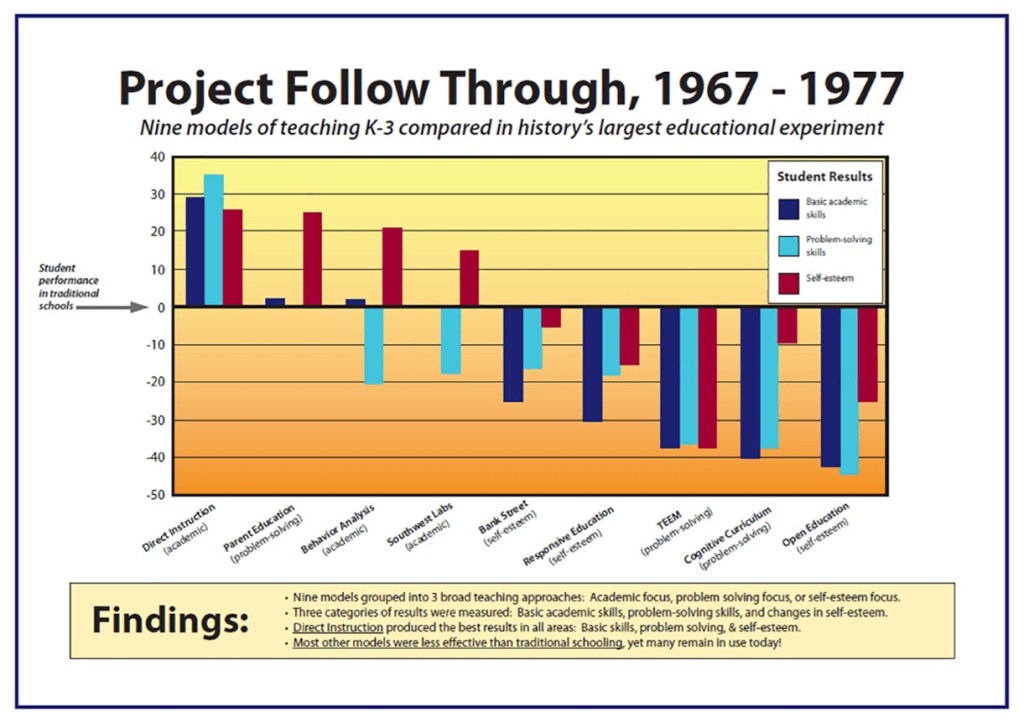
Figure 4: Findings from Project Follow Through (NIFDI, 2024)
Engelmann’s approach is based on some simple assumptions, philosophical principles, and guidelines for teaching strategies. In summary these are:
Assumption 1: All children have the capacity to learn any quantity that is exemplified through examples.
Assumption 2: All children have the capacity to generalise to new examples on the basis of sameness of quality, and only on the basis of sameness.
Principle 1: All children can be taught.
Principle 2: All children can improve academically and develop a stronger self-image.
Principle 3: All teachers can succeed if provided with adequate training and materials.
Principal 4: Low performers and disadvantaged pupils must be taught at a faster rate if they are to catch up to higher-performing peers.
Principle 5: All details of instruction must be controlled to minimise pupil misinterpretations and to maximise learning.
Guideline 1: Prerequisite skills for a strategy should be taught before the strategy itself.
Guideline 2: Instances consistent with a strategy should be taught before exceptions to that strategy.
Guideline 3: Easy skills should be taught before more difficult ones.
Guideline 4: Strategies and information that are likely to be confused should be separated in the teaching sequence.
Many might read this list and consider it to be mostly common sense or self-evident, but I am sure if much practice were to be analysed then it would be often found to fall short in various ways. As well as following the guidelines above, teaching strategies should also be chosen carefully to ensure those used have the widest explanatory power and applicability whilst being as simple and easy to follow as possible. For example, as a physics teacher it drives me crazy when I see teachers using the dead-end of formula triangles to teach how to solve numerical problems. It is a strategy that requires more rote memorisation than learning the underlying algebraic principles and does not prepare pupils for when they meet even relatively simple equations such as EK = ½mv2 or EH = cmDT let alone v2 = u2 + 2as. I refer you back the grainy old video for an example of how even very young children can gain an understanding of such things if they are taught it well. For relatively simple introductions to these assumptions, principles, and strategies please see the books by Tom Needam and Kurt Engelmann (Engelmann, 2024; Needham, 2026) but for the full experience go to the Theory of Instruction (Engelmann and Carnine, 2016).
Direct Instruction programmes have not been developed for teaching subjects like physics to older pupils, but I am sure that if the principles and strategies developed by Engelmann and colleagues still apply. There is just a job of work still to be done to develop good instructional materials based on Engelmann’s ideas. There is an overlap between the principles and strategies developed by Engelmann and findings from cognitive science. I hope that in the future teachers recognise that as well as knowledge of the subject matter they teach that knowledge of Engelmann’s approach and from cognitive science as well as generic pedagogical knowledge such as behaviour management strategies form the foundational knowledge-base for teaching (Institute of Physics, 2024).
Cognitive science
The examples of Haagen-Schützenhöfer and Engelmann described above mostly focus on the iterative process of good instructional design more than specific content as this can vary greatly from subject to subject etc. However, something else which should also be considered during instructional design is the significant developments in cognitive science and cognitive psychology in recent years. Although Engelmann and Carnine wrote the first edition of Theory of Instruction in 1982 there is much that is consistent with findings from cognitive science in the decades since. Whereas Engelmann and Carnine’s work was predominantly gained from study of what works in the classroom, many of the findings from cognitive science come from ‘lab-based’ studies although I often think this term misrepresents the true context of much of the research. It often just means it has been done with artificially constructed groups of pupils or students, and frequently with undergraduates rather than school age pupils. Nevertheless, I think it is an important part of teacher professionalism that teachers consider how research findings might best transfer to their own context when thinking of instructional design.
The awareness and discussion of cognitive science, and indeed of the importance of the curriculum and curriculum-making, seems to be more developed in England than in countries elsewhere, certainly than in Scotland. Here it seems that practice is patchy, as I have also found when speaking to teachers in Europe, Canada, Australia and New Zealand. I think that many of the educational reforms introduced by the Westminster government in English education in the 2010s together with the growth of teacher blogs and ready communication via Twitter, before it was broken by its new owner, resulted a quite unique ecosystem that allowed innovation to flourish in a way not matched elsewhere. However, there are lessons to be learned from England too. Simplistic and over-rigid enactment of findings from cognitive science, or that are claimed as to be from cognitive science, can easily lead to lethal mutations. When inclusion of retrieval practice in lessons ends up being multiple choice questions at the start of every lesson being mandated by school leadership then I am sure any benefits will be diminished along with teacher agency and motivation. It is important that teachers have access to research-informed information, support and adequate time to digest how such information can be transferred to their context, and the trust and agency to then incorporate such knowledge into their practice based on their wisdom of practice then we will have moved towards a more professional teaching profession.
There is much from cognitive science in common with Engelmann’s approach such as the breaking down of new material into small chunks to avoid cognitive overload, the interleaving of materials together to give more distributed and spaced practice, the use of retrieval practice, and the gradual removal of scaffolding as pupils’ expertise in a topic builds. My own deep dive to many of these ideas began with David Didau and Nick Rose’s book (Didau and Rose, 2016), but there has been an explosion of useful texts, blogs and Substacks since. There is also much in common with mastery approaches where pupils are not moved on to more advanced work before achieving a high success rate in pre-requisite and easier work. Mark McCourt’s book gives a very good introduction to mastery approaches (McCourt, 2019).
Conclusion
This blog has discussed some processes which can be used in instructional design and some sources of information that teachers can use to inform and improve that process. In the next blog I will discuss some more concrete examples from my own experience about how good instructional design can be enacted in practice.
References
Deng, Z. (2020) Knowledge, Content, Curriculum and Didaktik: Beyond Social Realism. Abingdon: Routledge.
Didau, D. and Rose, N. (2016) What every teacher needs to know about … Psychology. Woodbridge: John Catt.
Engelmann, K. E. (2024) Direct Instruction: A Practitioner’s Handbook. Woodbridge: John Catt.
Engelmann, S. (2007) Teaching Needy Kids in Our Backward System: 42 Years of Trying. ADI Press.
Engelmann, S. and Carnine, D. (2016) Theory of instruction : principles and applications (Revised Edition). NIFDI Press.
Guskey, T. R. (2016) ‘Gauge impact with 5 levels of data’, Journal of Staff Development, 37(1), pp. 32–37. Available at: https://uknowledge.uky.edu/cgi/viewcontent.cgi?article=1059&context=edp_facpub.
Haagen-Schützenhöfer, C. and Hopf, M. (2020) ‘Design-based research as a model for systematic curriculum development: The example of a curriculum for introductory optics’, Physical Review Physics Education Research, 16(2), pp. 020152-1-020152–24. doi: 10.1103/PhysRevPhysEducRes.16.020152.
Hestenes, D. et al. (no date) Force Concept Inventory (FCI). Available at: https://www.physport.org/assessments/assessment.cfm?A=FCI.
Institute of Physics (2024) Subject knowledge framework for teaching physics | IOPSpark, IOP Spark. Available at: https://spark.iop.org/framework.
McCourt, M. (2019) Teaching for Mastery. Woodbridge: John Catt.
Needham, T. (2026) Engelmann’s Direct Instruction in Action. London: Hachette Learning.
NIFDI (2024) Project Follow Through. Available at: https://www.nifdi.org/what-is-di/project-follow-through.html.
Priestley, M. et al. (2025) Towards a typology of curriculum policy approaches. IBE UNESCO. Available at: https://unesdoc.unesco.org/ark:/48223/pf0000393083.
Surma, T. et al. (2025) Developing Curriculum for Deep Thinking: The Knowledge Revival. Springer. doi: 10.1007/978-3-031-74661-1.


Leave a Reply