In October, alongside a trip to see my daughters in Australia, I arranged to visit in person several people from the education world in both Australia and New Zealand who I had met previously, mostly online. They in turn arranged various visits and meetings where I was able to meet with many others. Alongside this I built in time to be a tourist to see some of the spectacular scenery in New Zealand and attend the Australian MotoGP round at Phillip Island, one of the best motorcycle racing circuits in the world. The month-long trip surpassed my expectations.
The timing of the MotoGP round dictated the time of my visit, as well as me wanting to avoid the high temperatures in an Australian summer or the worst winter weather in New Zealand’s mountains (more of that later). Therefore, purely by luck, my visit coincided with the publication of the new draft New Zealand curriculum for Years 0-10 (Ministry of Education, 2025) which is now out for consultation. I was familiar with the background to developments in the sciences curriculum thanks to several online conversations over several years with David Housden, Assistant Principal at St. Bernards College in Wellington, who chairs the New Zealand Institute of Physics (NZIP) Education Section. A few years ago, when David sent me details of the existing physics curriculum, I must admit to thinking he had forgotten to attach the main documents. The competency-based curriculum provides very little guidance to teachers on the content of the curriculum despite there being national examinations at the end of it. I could only conclude that teachers were having to rely on past papers and/or custom and practice through experience to determine what they actually need to teach. This scenario is likely to disadvantage pupils of teachers not ‘in the know’ and to widen disadvantage gaps. Similarly, the science curriculum for primary age pupils was vague, even more so in my view than the Experiences and Outcomes (E&Os) for the Broad General Education (BGE) phase of the Scottish curriculum. David, along with his two NZIP colleagues Brenda McKechnie and Sue Napier, arranged for me to speak at meetings of physics teachers in Wellington and Christchurch. I spoke about the recent curriculum design principles published by the IOP (Institute of Physics, 2024), some of the research on knowledge-rich compared to competency-based curricula, and the curriculum changes taking place here in Scotland, comparing them with what is happening in New Zealand. It was also good to hear the initial reaction of teachers to the newly published draft curriculum when I was in Christchurch just two days after their publication.
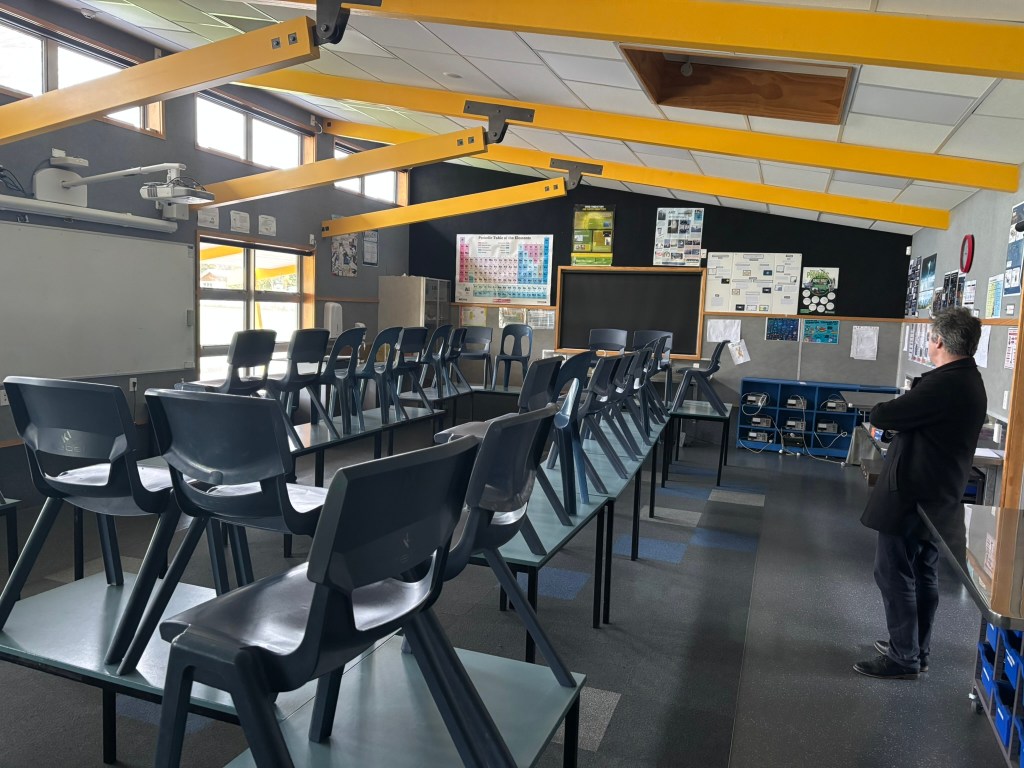
David Housden in his physics lab at St. Bernard’s College, Wellington.
One of the things I was keen to do whilst in New Zealand was to visit a few schools to get a better idea of what actually happens in practice than one can glean from policy documents. My PhD study (Farmer, 2024) was predicated on the fact that the lived experiences of teachers in schools does not align well with what is stated in national policy documents in Scotland. By speaking to teachers, both at meetings and individually, and by visiting schools I hoped to get a better understanding of what happens in practice. This included being hosted by two teachers I knew when they taught physics in England, Kerry Parker and Alex Weatherall. Both have emigrated to New Zealand, and it was good to meet up with them again and to visit their schools too. I was able to visit six high schools in total, three on the North Island and three on the South Island, across five towns or cities. I was able to visit three during the school day when pupils were present, and to sit in on one full physics class in one of them as well as be given a tour of that school by three of the pupils during which I was also able to ask them about their experiences there. I was visiting in the last few days before senior pupils went off on study leave for their end of year exams, so it was perhaps not the most representative time of year, but it was instructive nonetheless. I visited the other three schools at the end of the school day and was given tours of their facilities, including the dining hall in one of them when their boarders were having their evening meal. This was one of the main differences I found out about compared to Scotland. I was interested to find out how New Zealand deals with large sparsely populated remote and rural areas similar to those we find in places like Argyll and Bute and Highland in Scotland. Boarding is much more common in New Zealand than here, partly I suspect facilitated by pupils remaining in primary school until Year 8 and then only having five years of high school. The other major difference is that most schools are either all boys or all girls with relatively few being co-educational. For obvious reasons, schools in the some of the most sparsely populated areas tend to be co-educational, but there are relatively few in more populous areas. For example, it surprised me that a town like New Plymouth has four high schools, a boys one and a girls one for Catholic pupils and the same for non-denominational pupils. Each therefore with a wide catchment area. As a result, there are a significant number of boarders from surrounding rural areas.
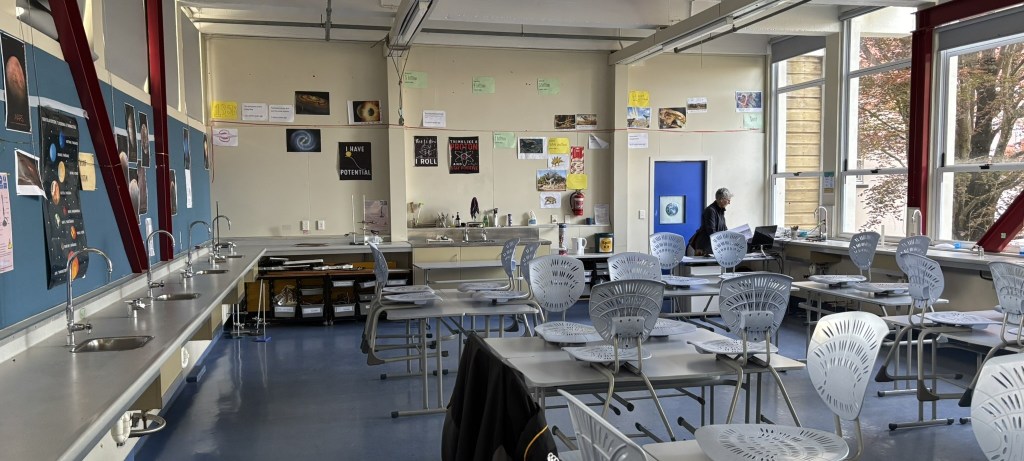
Kerry Parker in her physics lab in New Plymouth Boys’ High School.
All the schools I visited seemed relatively tidy and well-respected by the pupils, as indeed was the country in general. There was a low level of litter and graffiti and roads were well maintained, verges cut etc. much as I remember being the case in Scotland before council budgets were continually squeezed. All the schools seemed to be fairly relaxed but nevertheless purposeful environments. Several of the schools were newly built, a result of natural disasters such as floods and the large earthquake that damaged much in Christchurch, but also a government school estate investment programme. Science labs tended to all have a similar design with desks and chairs in the middle with benches with services around the outside walls. David informed me that this was a design which had been effectively mandated by the Ministry of Education although it is a design I dislike as pupils are standing with their back towards you when doing practical work and it is hard for a teacher to monitor what they are doing. It also means there is limited bench space for practical work. To find out what expectations are regarding practical work I also find it instructive to look in stores and technician rooms in schools to see the quantity, age, and state of repair of the equipment. This is something with which I have had a longstanding interest having done my MBA dissertation (Farmer, 2003) on the funding for physics practical work over two decades ago and I also led on the work the Learned Societies Group on Scottish STEM Education did on this more than a decade ago (Farmer, Hardie and Brown, 2015). I did not see evidence of there being a lot of practical work being done in physics classes in New Zealand schools, and certainly not with modern equipment in sufficient numbers to allow for practical work in pupil pairs.
In addition to meeting with teachers, it was a pleasure to meet with several people with leadership roles in the ongoing curriculum reforms. First, David Housden put me in touch with Michael Johnson of the New Zealand Initiative who chaired the Ministerial Advisory Group which advised the Education Minister, Erica Stanford, on the development of a knowledge-rich curriculum. He now sits on the National Curriculum Coherence Group. I met with Michael on Teams ahead of my visit but unfortunately my meeting with him in Wellington was cancelled as he was stuck in Christchurch as all flights were cancelled due to the unusually stormy weather and high winds. However, after a phone call with him, he put me in touch with another member of the Coherence Group, Catherine Law, Principal of a girls’ high school in Christchurch. I was able to meet with Catherine on her last day before starting a secondment at the Ministry of Education leading the Year 11-13 curriculum developments, broadly similar to our Senior Phase in Scotland. With it being her last day in post, she no doubt had other things to be doing than speaking to me, but she gave me a good hour of her time and a quick tour of her school’s science department. Catherine has recently completed a doctorate in curriculum design and how teachers can use the Curriculum Design Coherence (CDC) Model (Rata, 2024) to support their curriculum-making in schools. We had a very interesting discussion including the great similarities between curriculum developments in Scotland and New Zealand, the importance of ensuring that the teaching profession is well-informed about the rationale of any change and provided with good support and professional learning to ensure it is enacted with fidelity, and about our own recent doctoral journeys.
In addition to my contacts through physics teaching, I had met Bronwyn Wood of Victoria University Wellington at a curriculum symposium at the University of Stirling Centre for Research into Curriculum Making earlier in the year when she was over on sabbatical. She had given a good presentation about curriculum developments in New Zealand providing information about the philosophical background of developments and some of the challenges involved. At the end of the day, it had also been good to have a more in-depth discussion with her, Andy Brown and Andy Creamer who have leading roles in the curriculum improvement cycle here, and Joe Smith from the University of Stirling. Although she was still going to be on sabbatical visiting a university in England when I was in Wellington, she put me in touch with her colleague Taylor Hughson and one of their master’s students, Colin Lambie, who is doing his dissertation comparing primary science curricula across different countries. I was pleased to be able to be interviewed by Colin and discuss the curriculum in Scotland with him to provide data for his study. Taylor put me in touch with Marc Clement and colleagues who work at the Ministry of Education and were in the final stages of completing the draft Year 0-10 science curriculum.
I was privileged to be able to meet with Marc and colleagues for more than two hours and for some of that time also with Julia Novak who leads the curriculum developments at the Ministry of Education. As was the case with Catherine Law mentioned above, I am sure they had a great deal going on as it was exactly a week before publication, but they gave of their time very freely and we had a good discussion about the similarities between what they are trying to do and the developments here. When in the Ministry of Education in Wellington I also met briefly with Ben Jensen of Learning First in Australia. Drawing on his extensive experience in education reform and curriculum analysis and development at the OECD and the Grattan Institute as well as at Learning First, he has been advising the Ministry of Education in New Zealand. I certainly had a productive few hours at the university and Ministry in Wellington including a sneak peek at some of the draft science curriculum.
Some of the reasons for curriculum change in Scotland and New Zealand are very similar. For example, the performances in international assessments have been poor, and the specification of the content of the curricula are ‘vague’ resulting in teachers calling for greater clarity whilst also wishing to retain some autonomy to tailor teaching and learning to local needs. However, one of the big differences between New Zealand and Scotland is that New Zealand has three-year parliamentary terms, and because they do not have a local authority structure like Scotland, there are very few meso-level structures between the Ministry at the macro-level and individual schools at the micro-level. This means that the national government has a much more direct influence on schools. The current round of curriculum reforms had begun under the previous government but when the current government, led by the National Party, came to power two years ago developments took a strong turn towards introducing a knowledge-rich curriculum to replace the current competency-based curriculum, much as has been set out in the case for change report published by Education Scotland (Education Scotland, 2024). The New Zealand Ministry of Education had looked internationally at high-performing countries such as Singapore and England which had already moved towards knowledge-rich curricula for some inspiration.
There are significant differences, one being that whilst Scotland is moving to a Know/Do/Understand curriculum model, New Zealand is moving away from this and placing the emphasis on Know and Do with clearly set out Knowledge and Practices statements. Any remnant of Understand has been incorporated into quite short purposes statements, the assumption being that if concepts are built effectively through a coherent progression of Knowledge and Practices that good Understanding will follow. In addition, in New Zealand there is no overt equivalent to the cross-cutting themes some are promoting quite strongly in Scotland. The emphasis in New Zealand has been placed on having strong conceptual development in the different subjects as a means of providing a sufficiently balanced and rounded curriculum. I must admit to having grave concerns that by placing emphasis on cross-cutting themes in a new curriculum model in Scotland that there is a danger of derailing the whole curriculum model and not addressing the issue of decluttering the curriculum but instead creating a bloated, overly complicated curriculum model which increases bureaucracy and teacher workload without benefits to pupil learning. I think, and it seems pretty much everyone with whom I speak, especially teachers, want to see any cross-cutting themes built naturally into subjects. I very much like the simplicity and emphasis of the proposed New Zealand curriculum. It provides very clear guidance to teachers about how concepts and topics ought to be progressively built up across Years 0-10 which will greatly simplify shared curriculum planning, resource production and sharing, and teacher professional learning.
Another significant difference, no doubt stimulated by the short parliamentary term, is that the pace of change has been much faster in New Zealand than Scotland. The recently published for consultation draft curriculum was written by relatively small Ministry teams, I think only three for the sciences, with some consultation with a limited number of ‘critical friends’ under non-disclosure agreements. This is in marked contrast to developments in Scotland where it has taken over a year to establish only drafts of the high-level ‘big ideas’ and ‘overarching concepts’ of the sciences curriculum with work on the know and do statements yet to follow. For the sciences, this process has involved a small staff team at Education Scotland, but still larger than the Ministry team in New Zealand, and has also involved three day meetings plus online meetings of a Collaboration Group of over 100 people, eight days plus online meetings of a Core Group of 36 people, several days of focus group meetings with others on specific issues such as the Senior Phase and Additional Support Needs (ASN), and online involvement of several hundred Critical Friends. None of this has been conducted in secret and participants in the Core Group have been encouraged to have dialogue about the process and progress made with others through their networks, even if at times there has been frustratingly little progress to speak about. My professional view, based on many years of experience in curriculum and assessment development, is that neither of these processes are ideal, with something in-between being much more appropriate. That is to have an expert group, sized somewhere between the 3 in New Zealand and 36 in Scotland but with a breadth of well-informed voices with experience and expertise in curriculum-making, given an extensive period of time to properly discuss and develop a draft curriculum for a subject area which then gives something concrete to then take to a wider group for consultation. This is likely to make much more efficient and effective use of the time of the expert group as well as give more meaningful focussed consultation. This is something I have already written about in the Curriculum Journal (Farmer, 2025).
The openness of the process in Scotland has been good as it has allowed some testing of ideas with a wider audience before deciding whether or not to take these forward, however, the validity of the feedback relies on the ideas being well enough explained, and well enough understood, which I do not think has always been the case in the often limited time and opportunities available. I think that in both countries it is becoming clear that the success of the curriculum development process depends on good clear messaging about the thinking which has taken place before decision have been made. Without this, the rationale for the draft proposals is not necessary understood by everyone and many can jump to inaccurate and unjustified conclusions about what is intended. I know that others involved in the process in Scotland, as well as myself, have had conversations with others where we have met significant scepticism or disagreement from others until we have had a chance to explain the issues sitting behind the decisions and proposals, only to be then met with a change of heart about them. Around the launch of the draft curriculum in New Zealand, several ‘roadshows’ were held around the country for school principals. Whilst this was a good start, it only involved a limited number of people and opened the likelihood of the message being distorted by a Chinese whispers process as the messaging spread further, especially to groups and in subjects where the new curriculum involves a significant change to the status quo. It was clear from speaking to teachers whilst in New Zealand, communication since, and from seeing news headlines, that there is significant pushback in some quarters to what is being seen as a top-down, and possibly politically motivated change. Although having spoken to key people involved, I think the motivation is to improve the education of the young people and is not political.
In relatively hierarchical subjects such as my own, physics, the importance of the well-considered development of concepts through the schooling of young people has been long recognised, be that involving substantive, procedural, or epistemic knowledge. The move from a competency-based to a knowledge-rich curriculum is therefore less of a hard sell than in some other curriculum areas, although I am convinced that knowledge is important in all curriculum areas, but this has been under-recognised by many in Scottish education in recent decades. That mathematics, another very hierarchical subject, has been used as a ‘pilot’ for the curriculum improvement cycle (CIC) in Scotland perhaps makes it easier for some working in other curricular areas where this is not the case to be more cynical about lessons learned also being applicable to their area. However, this just emphasises the importance of being able to explain the rationale of a move to knowledge-rich curriculum clearly to everyone, especially by using concrete examples of the benefits across the different subjects. I think there is much we can learn here in Scotland from the recent experiences in New Zealand and I have already connected several people with whom I met with others involved in the CIC which has led to several very positive and productive follow-up meetings.
Before heading to New Zealand, I spent a few days in Melbourne. John Cripps Clark of Deakin University hosted me and arranged for me to speak at a meeting of the Vicphysics Teachers’ Network on the Deakin Downtown Campus. Dan O’Keefe and Barbara McKinnon of Vicphysics made sure that teachers not able to make it into the centre of Melbourne were able to join online. I spoke about effective professional learning, drawing on my PhD research and on my work over many years with the IOP, including its Physics Teachers’ Network. In addition to the Vicphysics meeting, John took me on visits to Whittlesea Tech School and the Victorian Space Science Education Centre (VSSEC).
The Whittlesea Tech School is one of several regional Tech Schools across the Melbourne area where other schools can bring their pupils for an enhanced STEM experience. Its Director, Sandra McKechnie, gave us a tour of the facilities and described the programmes they provide. VSSEC is one of six specialist centres on different science topics available to schools in Victoria. It is built on a high school campus but is available for other schools, primary and secondary, to bring their pupils in for space science related activities. As well as more traditional science lab spaces they have a primary science lab kitted out like a space station on Mars and a mission control centre and a simulation of the surface of Mars where classes can be split in two to run simulated missions on Mars, half in mission control and half as astronauts on the simulated Martian surface. This is a similar to the Challenger Centers found across the USA. It was a pleasure to meet with its Curriculum Manager, Mark Gleeson, its Director, Michael Pakakis, and colleagues to discuss its aims and how it operates. As with my visits in New Zealand, staff in all the institutions I visited gave of their time very freely and our conversations frequently overran. I also met with Jackie Bondell who works on physics outreach projects at Swinburne and Melbourne universities. I had met Jackie previously as part of my involvement with the Einsteinian Physics work of Magdalena Kersting of the University of Copenhagen and David Blair of the University of Western Australia (Kersting and Blair, 2022). It was good to see how an enhanced provision in the STEM subjects beyond that which individual schools can provide is being delivered in a co-ordinated way.
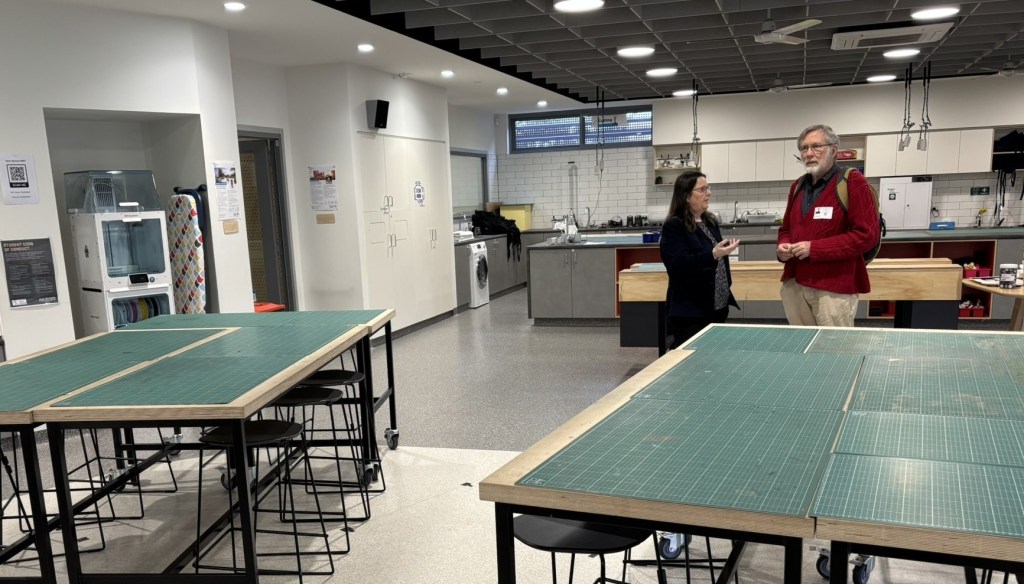
Sandra McKechnie and John Cripps Clark in one of the teaching spaces in the Whittlesea Tech School.
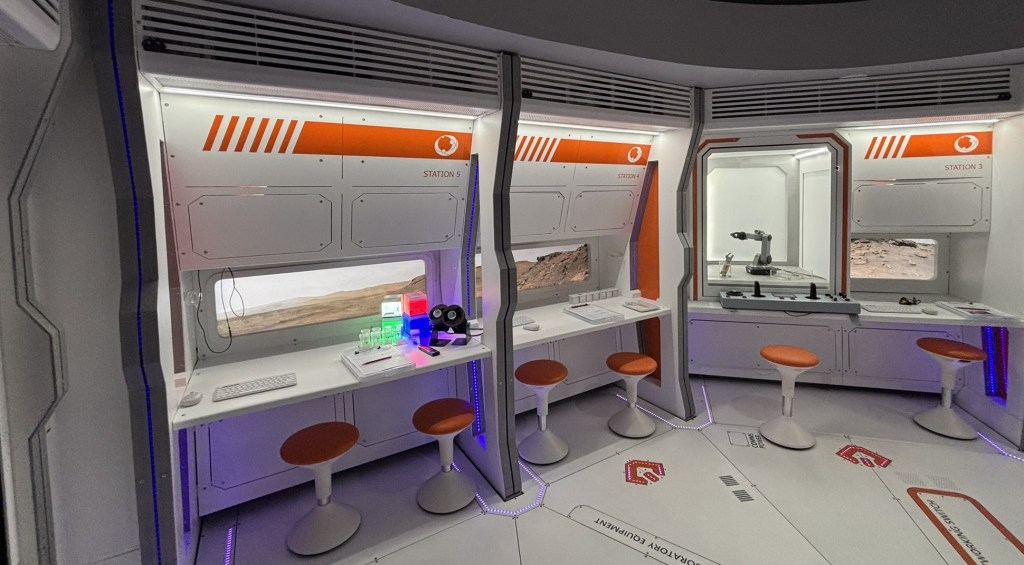
The primary science lab kitted out in the style of a Martian base at VSSEC.
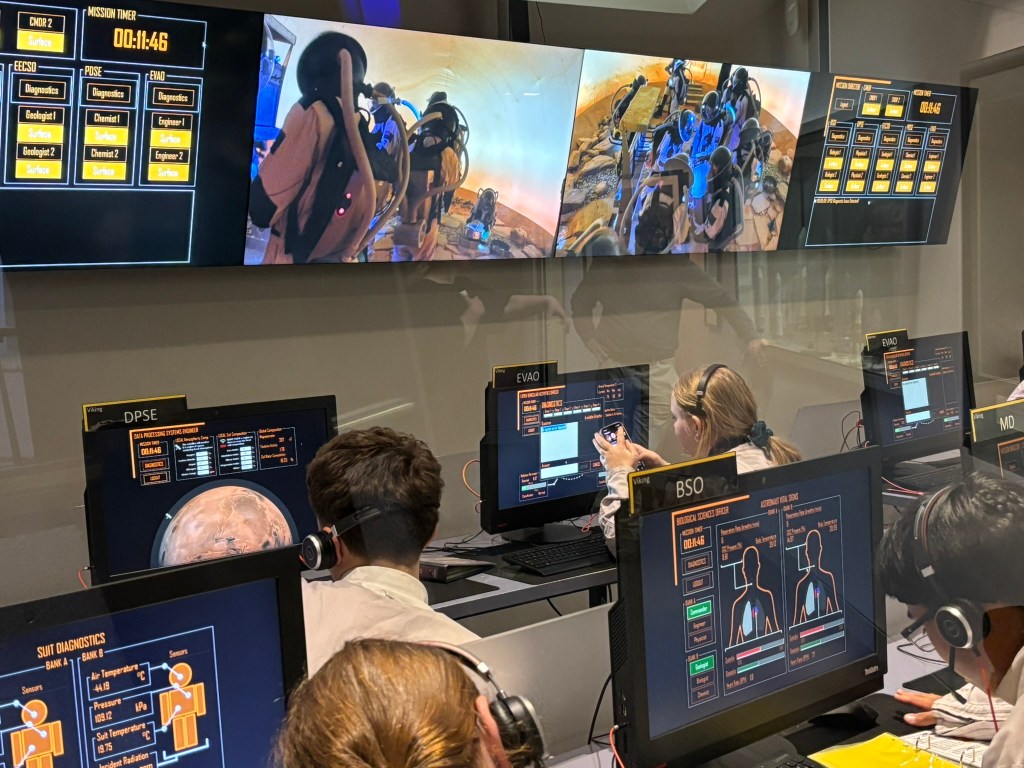
Mission Control at VSSEC.
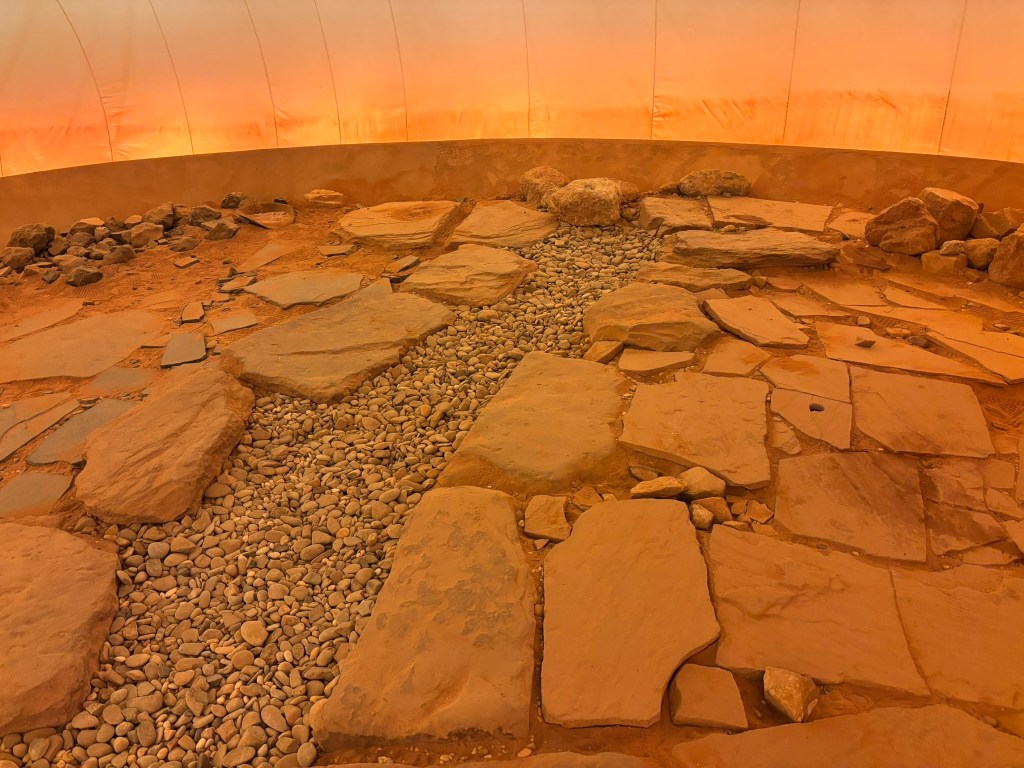
The simulated surface of Mars at VSSEC (after the pupils shown above had departed).
Finally, I mentioned earlier that I would say more about the weather. The MotoGP was relatively little disrupted by the weather. MotoGP rounds at Phillip Island which is perched on the cliffs of the southern coast of Victoria on the edge of the Bass Strait, next stop Antarctica, are notorious for being weather disrupted, however, apart from a little early morning dampness and a delay of one hour to the programme on the Sunday to allow high winds to subside, my main problem was getting a badly sunburned nose thanks to underestimating the width of the brim of my hat and my ability to spread the factor 50 evenly.
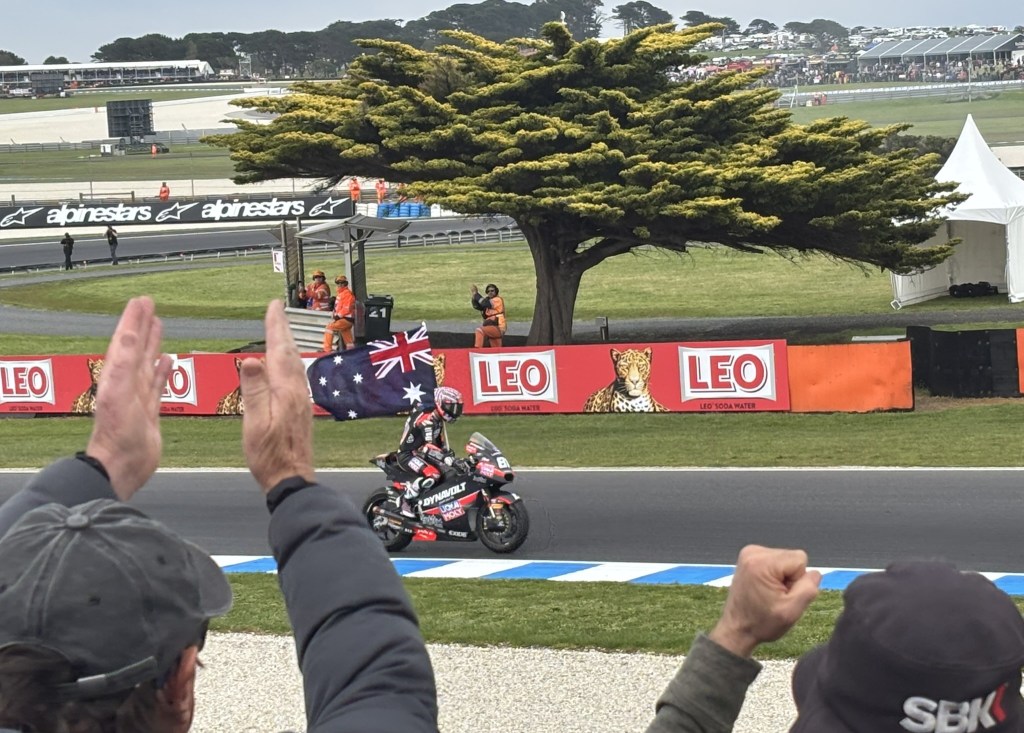
Senna Agius celebrating a home win in the Moto2 race at Phillip Island.
I flew from Melbourne to Wellington, the world’s windiest city, on Monday 20 October just before a storm was due to hit. This closed the airport a few hours after I arrived. It was extremely windy the following day, and even the locals were commenting on how unusual this was. I had a lovely drive to New Plymouth the next day but that night and the following morning it poured with rain. Visibility was poor and I had to negotiate several landslips that had partially blocked roads on my way to Rotorua. Fortunately, the next day when I made my way back to Wellington via Taupo and Napier was clear and sunny. However, whilst I was enjoying good weather on the east of the North Island, the north of the South Island was being battered by another storm. It had just blown through when I flew from Wellington to Christchurch, and I got some spectacular views of several rivers in spate, delivering lots of brown water into an otherwise gorgeous blue ocean.
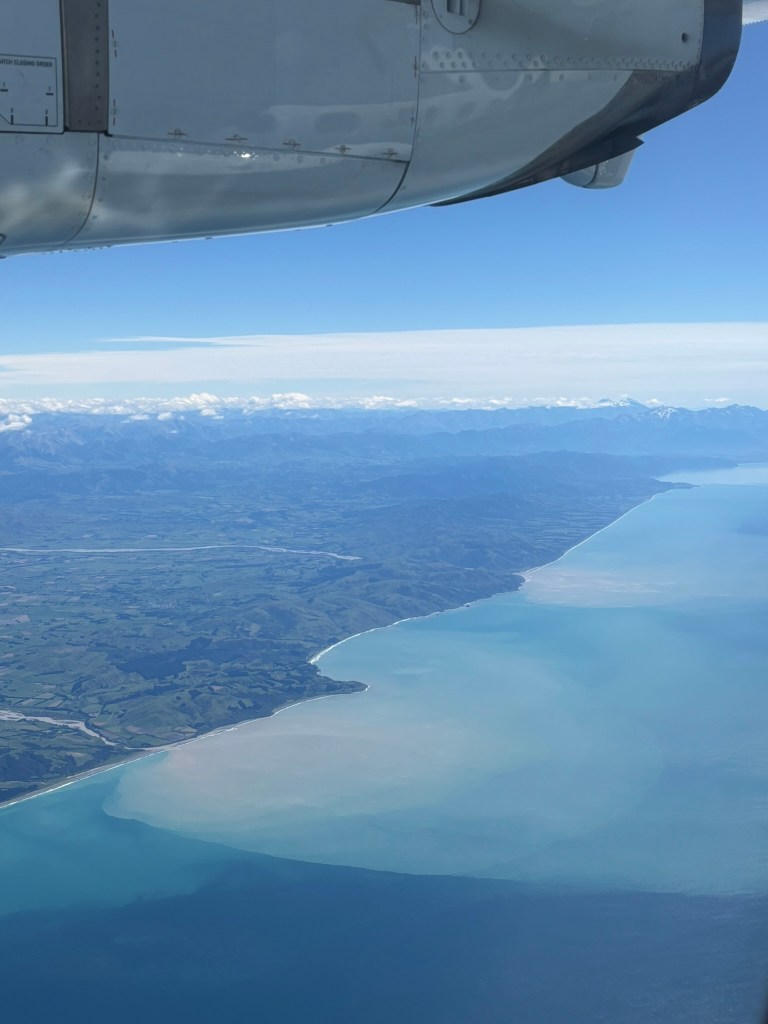
Evidence of the storm and heavy rain that had hit north of Christchurch.
The road from Christchurch to Hanmer Springs had been closed and Hanmer Springs left without power. Fortunately, just before I got there, power was restored and the road reopened but there were very many fallen trees and others that seemed to have just shaken themselves to pieces. The storm had washed away part of the road through the Lewis Pass between Hanmer Springs and Hokitika which was my next planned stop but fortunately it was reopened with one lane across a temporary gravel road just hours before I was due to drive through it. I did experience heavy rain and sleet through the mountains though. I had been contemplating having to make a long detour south through Arthur’s Pass as an alternative. My next day was from Hokitika down the west coast and through the Haast Pass to Wanaka. I have never driven with a car’s wipers on fast speed for so long and saw several more landslips along the way, as well as some spectacular waterfalls, but not much else due to the low cloud and heavy rain. Having made it to Wanaka, snow started falling blocking the Haast Pass behind me. I abandoned plans to visit Queenstown for a quick visit and holed up in the motel.
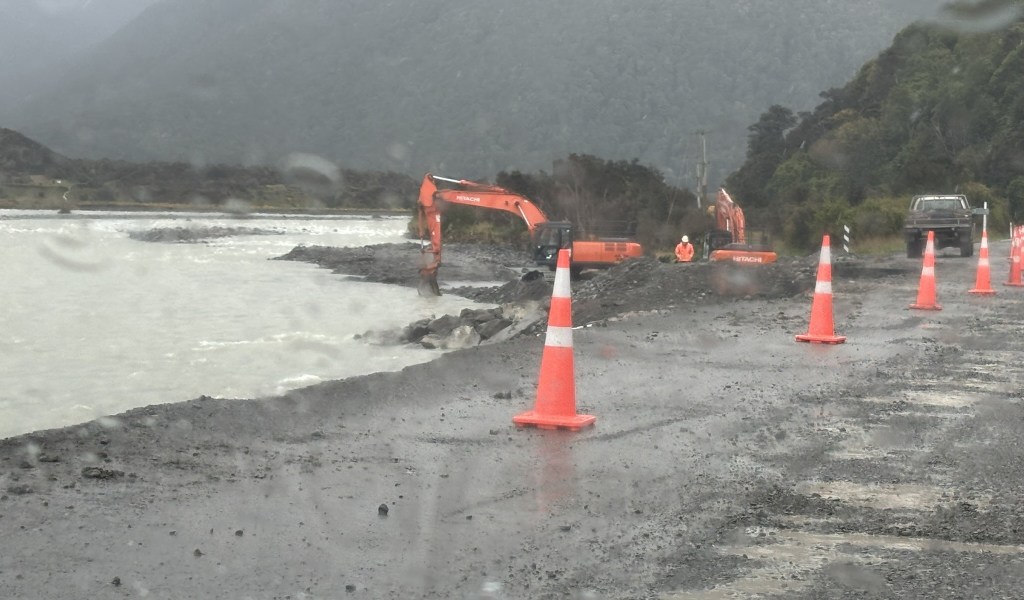
Road repairs in the Lewis Pass.
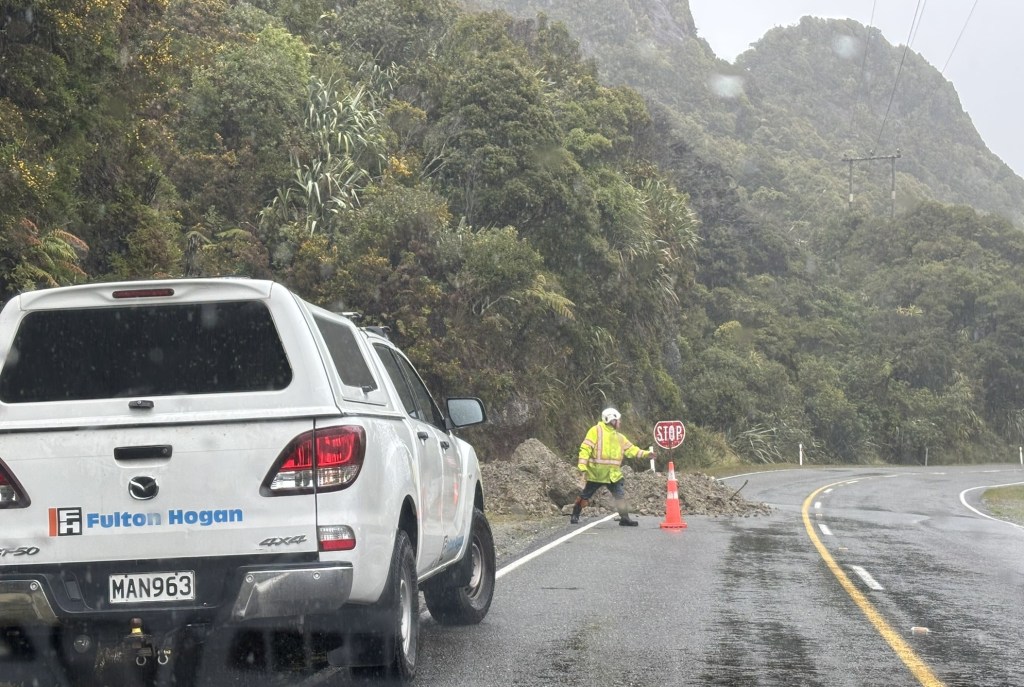
One of many landslips I encountered on my travels.
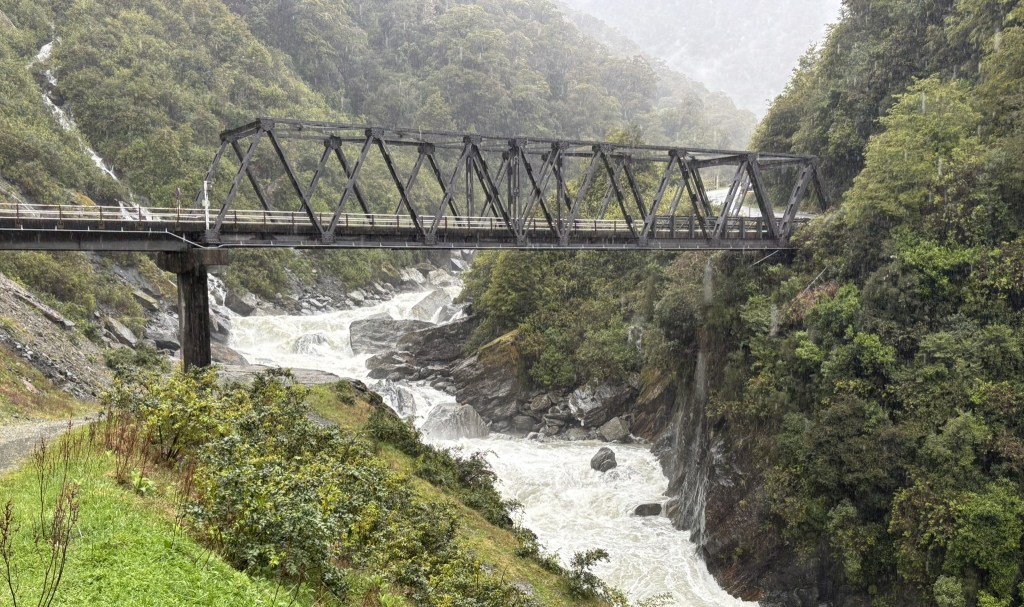
Heavy rain in the Haast Pass.
Unfortunately, the snow had also blocked the four most direct routes from Wanaka to Timaru where I was due to meet Alex Weatherall the next day. As I left Wanaka towards Alexandra, all the roads out of Wanaka apart from the one heading down the Clutha River valley to Milton were still showing closed on the New Zealand Traffic Authority app. The hydro-electric dam at Clyde was spectacular as they released a huge volume of water down the spillway and through the power station.
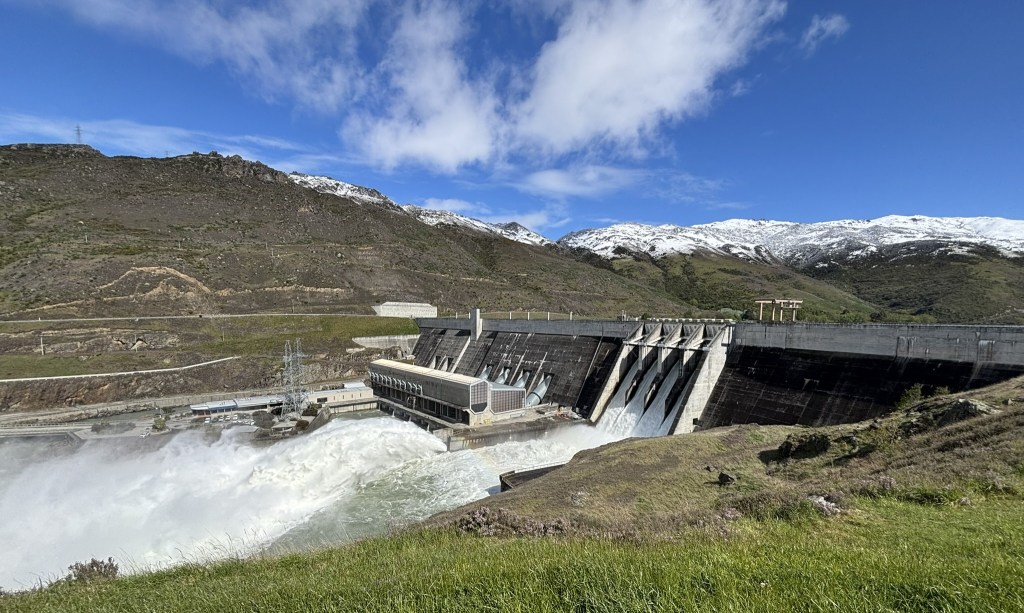
Releasing water through the Clyde hydro-electric power station and dam.
Fortunately, when I got to Alexandra, and the decision point at the fork in the road, the N85 to Palmerston was showing open but to pass with care. This was going to save several hours compared to the lower-level route south-east to the coast before heading north again. What followed was several hours of driving through spectacular snow-covered scenery under cloudless blue skies on mostly dry black roads with occasional damp patches gently steaming as they dried in the sunshine, and only a very occasional other vehicle to disturb the peace. It very much helped make up for the previous day. I then made it from Timaru back to Christchurch in warm sunshine for the last couple of days of my visit. All in all, very unlucky with some unseasonable spring weather, but very luck that most of my itinerary escaped intact.
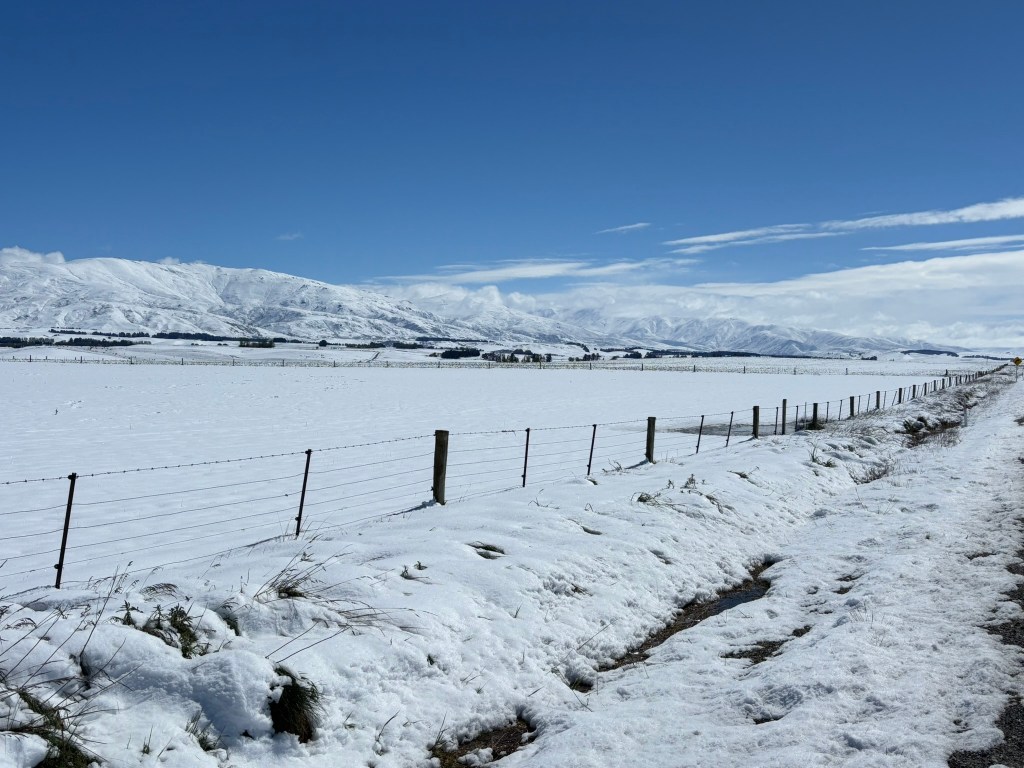
Fresh snow on the fields and mountains between Wanaka and Palmerston.
I think there is lots we can learn here in Scotland from New Zealand. Not only is it a country with a similar population and spread of geographies from urban centres to remote sparsely populated areas, but given the large numbers of people who emigrated from Scotland to New Zealand there are many cultural similarities too. As I drove around, it felt more similar to home than either Australia or Canada, much as Ireland feels quite like Scotland but just a little bit different. Almost every town and village I drove through had placenames, street names and other associations with Scotland. New Zealand does have a sizeable Māori population (~15%) which provides challenges we do not share but during my visit and the conversations I had with people the similarities between our two countries generally outweighed the differences. I certainly intend to keep in contact with many of the people I met, especially as they progress through their curriculum journey during the next few years. Thanks to them running ahead of and faster than us, they will encounter problems and hopefully come up with some solutions which can be useful for us to learn from, both good and bad. Designing a good physics curriculum should not be something that is radically different in any two countries. I also have some unfinished business with the scenery, both in the far north and south which I was unable to visit on this trip, but some of the bits in-between which were disrupted by the weather too. I hope to be able to go back.
References
Education Scotland (2024) Curriculum Improvement Cycle (CIC): Background and a Case for Change Findings from the Pilot Curriculum Reviews 2023/24: A Discussion Paper. Livingston. Available at: https://blogs.glowscotland.org.uk/glowblogs/public/cices/uploads/sites/10666/2024/11/13214842/CIC-A-CASE-FOR-CHANGE-PILOT-CURRICULUM-REVIEWS141124.pdf.
Farmer, S. (2003) Decisions about Funding Allocations: An Analysis of the Resourcing of Physics Departments in Scottish Secondary Schools. University of Leicester. Available at: https://www.researchgate.net/publication/382489712_Decisions_about_Funding_Allocations_An_Analysis_of_the_Resourcing_of_Physics_Departments_in_Scottish_Secondary_Schools.
Farmer, S. (2024) The alignment of policy and practice for the career-long professional learning of teachers in Scotland. University of Strathclyde. Available at: https://stax.strath.ac.uk/concern/theses/w66344189.
Farmer, S. (2025) ‘Curriculum development processes in Scotland: Who and how?’, Curriculum Journal. Available at: https://doi.org/10.1002/curj.352.
Farmer, S., Hardie, W. and Brown, S. (2015) ‘The resourcing of science in Scottish schools’, School Science Review, 357, pp. 84–89. Available at: https://www.researchgate.net/publication/375910790_The_resourcing_of_science_in_Scottish_schools.
Institute of Physics (2024) The fundamentals of 11 to 19 physics | Institute of Physics. Available at: https://www.iop.org/about/publications/fundamentals-11-19-physics.
Kersting, M. and Blair, D. (2022) Teaching Einsteinian Physics in Schools: An Essential Guide for Teachers in Training and Practice. Abingdon: Routledge. https://www.routledge.com/Teaching-Einsteinian-Physics-in-Schools-An-Essential-Guide-for-Teachers-in-Training-and-Practice/Kersting-Blair/p/book/9781760877712
Ministry of Education (2025) The New Zealand Curriculum | Te Mātaiaho. Available at: https://newzealandcurriculum.tahurangi.education.govt.nz/5637303584.p#Mātaiaho.
Rata, E. (2024) ‘The Curriculum Design Coherence Model’, Research Handbook on Curriculum and Education, pp. 261–279. doi: 10.4337/9781802208542.00025. Available at: https://www.researchgate.net/publication/379939464_The_Curriculum_Design_Coherence_Model.
 Stuart Physics
Leave a comment