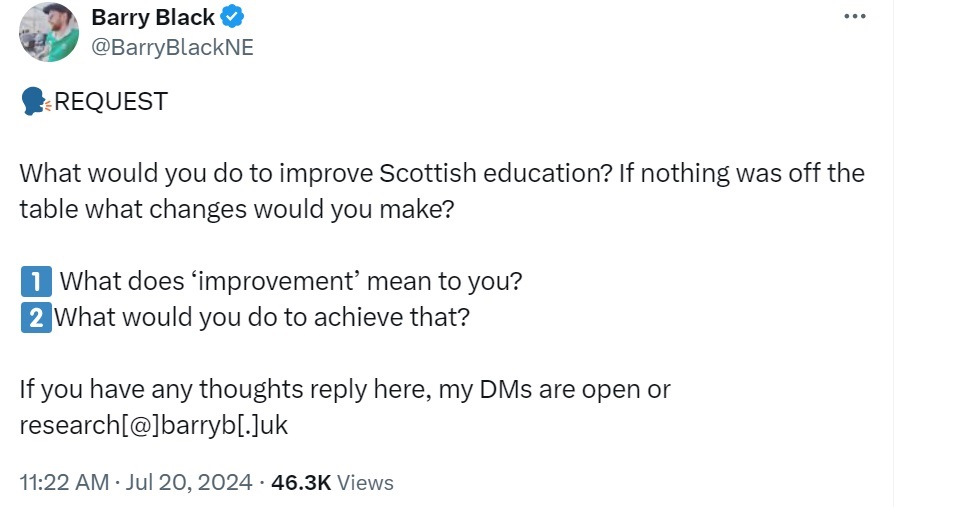
On Twitter on 20 July 2024, Barry Black asked what could be done to improve Scottish education, see his tweet below.
As I write this, he has received 78 replies from a wide range of individuals. Initially, I was hesitant to write a reply as the brevity of tweets are rarely the best way to address such a multifaceted issue, but on reflection, if one is to get one’s message over to politicians and policymakers, it is important to have a short and clear message. Therefore, on 25 July 2024, I replied to Barry’s question, and although I did not manage to keep my answer as brief as a single tweet, I did manage it in a short thread of fourteen. That afternoon, I had met with Barry in a café in Aberdeen and had a good chat with him. We discussed a range of issues, concerns and potential solutions for Scottish education, and my Twitter thread was in effect a summary of my main points when I tried answering his question. My Twitter thread, lightly edited into more normal prose, follows. By posting it as this blog, it is an attempt to make my answer more readily accessible to others. However, there is much more that could be said on the subject, and much nuance hidden behind some of the points I make.
My priorities for improving Scottish education
The most important thing is to refocus the system on supporting teachers improve their teaching in their classrooms as this will improve the outcomes for children and young people and result in improved system performance by default. This means giving teachers time and trusting them to identify their and their learners needs and providing them with the support they need to address these. A more bottom-up process than we have currently, but with better support from the middle and top.
This does need a proper review of the curriculum and the Curriculum for Excellence Experiences and Outcomes replaced with a curriculum that states clearly the common, powerful knowledge learners need at each step in each subject for successful progression beyond. Curriculum progression includes improved transition from the Broad General Education (ages 3-15) to the Senior Phase (ages 15-18). I do not think the Senior Phase needs radical change, but more fit-for-purpose assessments, such as the removal/replacement of National 5 and Higher Assignments in Physics.
Clear curriculum guidance will allow for improved, more focused professional learning in subjects at all levels. Teachers need time for this and the implementation of promised 90 minutes non-contact time is a good first step, but then needs trebled. This time needs to be used for good collaborative subject-specific enquiry-based professional learning focused on improving the instructional core in classrooms, including the networking of teachers in similar contexts across different schools. Such professional learning needs to be led by subject and pedagogical experts who are research and evidence informed, including from universities, learned societies and elsewhere. There also needs to be professional learning for those leading the professional learning of others.
Perhaps the most important subjects for high quality subject specific career-long professional learning are reading and maths in the early years and primary. Teachers need to be trained in research informed and proven pedagogies such as systematic synthetic phonics. National curriculum guidance and good quality core teaching resources need to be developed by teams of teachers working with others with expertise in curriculum, assessment, resource writing etc. We need to identify and include the right people to do this and ensure they are in the right rooms. Giving teachers clear curriculum guidance, high-quality starter resources, good professional learning and time to collaborate will not reduce teacher autonomy but empower them to develop teacher agency and to focus on improving teaching and learning.
These changes can only be fully realised if the performativity and managerial professionalism promoted by the culture of accountability and scrutiny that pervades Scottish education is dismantled and replaced by a genuinely transformative culture. This can only be done if there is more than a rebrand of the Scottish Qualifications Authority and Education Scotland as appears to be going to be the case despite what the OECD, Ken Muir etc. recommended in their reviews of Scottish education and the apparent initial intent of the Scottish Government. We have had enough reviews agreeing about the problems. However, it seems vested interests are dominating, much as many cynics predicted, and chance for genuine reform many hoped for is being missed. Everyone – the Scottish Government, local authorities, unions and teachers themselves need to be braver.
Some will say all this needs extra money, and things like increasing non-contact time will, but the education budget is large. The funding already available needs reprioritised and used to focus on the instructional core in classrooms. Things that do not should be stopped.
 Stuart Physics
Leave a comment