Many who know me will be aware of the value I give to good quality subject-specific professional learning. My research with physics teachers in recent years (Farmer, 2024; Farmer & Childs, 2022) has shown that alongside being able to spend good collaborative time with their subject colleagues they most value the sorts of professional learning offered by the Institute of Physics (Institute of Physics, n.d.) and SSERC (SSERC, n.d.). Part of the reason for this is undoubtably that much of the professional learning offered by these two organisations is focused on supporting teachers improve the instructional core in their classrooms. The professional learning also often integrates approaches to practical work, an important component of teaching and learning in physics, with the teaching and learning of knowledge, concepts and skills. A focus on valued student outcomes, on worthwhile content, and on the integration of knowledge and skills are the first three of Helen Timperley’s ten principles of effective professional learning (Timperley, 2008). That they are delivered by staff with knowledgeable expertise also ticks off principle number eight.
I write this having spent most of the week before last, along with others, organising and delivering the 49th annual IOP Stirling Physics Teachers’ Meeting and the joint IOP and SSERC Raising Attainment in Physics course. The latter of these was a slimmed down version of the residential Physics Teachers’ Summer School which has run in some form for over 20-years. Both events are well established events in the calendar of professional learning events for Scottish physics teachers. The initial evaluations of both events also show that those attending them found them very worthwhile and certainly my own professional judgement was that they were at least as successful as many of their predecessors have been.
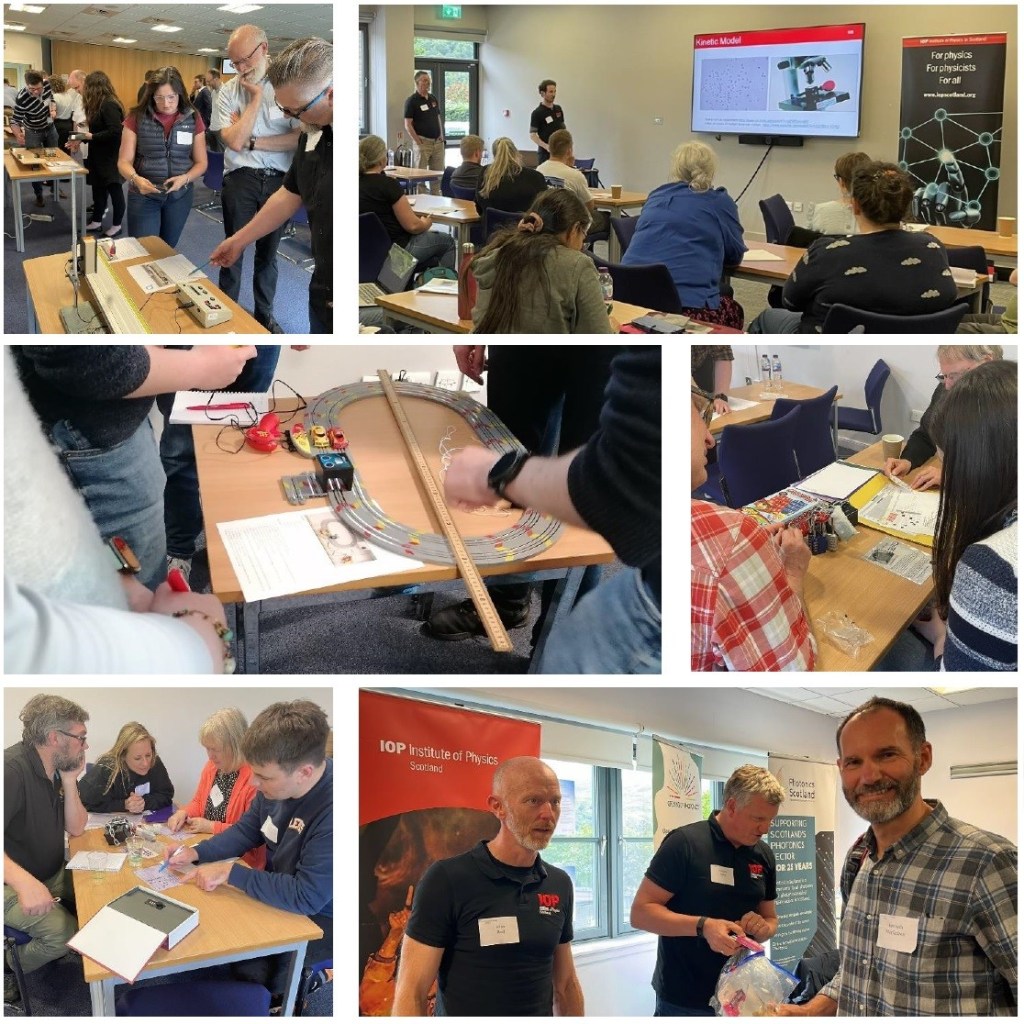
It is therefore disappointing that the attendances at both events were down compared to last year, and especially compared to the typical numbers before the COVID-19 pandemic. Around 125 attended the Stirling Meeting compared to over 150 last year, and close to 300 was not unusual a couple of decades ago. Teachers from Scottish state funded schools attending the Raising Attainment in Physics course receive back more than the course fee in the way of a bursary and resources to enable them to replicate activities once back in schools, and that is not adding in the cost of the two-day residential experience with all meals and hotel accommodation. Despite this, only eight teachers participated. We could have accommodated the twenty-two we typically had pre-COVID-19 when we had to cap the numbers to due to the size of the venues and there was the need for a competitive application process.
It is clear that the budgets of schools and local authorities are under pressure (Accounts Commission, 2023), and it may well be that schools have less funding to devote to teacher professional learning then previously. But thanks to IOP sponsorship and Enthuse bursaries, schools are in effect being paid if one of their physics teachers attends the Raising Attainment in Physics course. In addition, both it and the IOP Stirling Meeting are timed to occur shortly after the SQA physics exams when most Senior Phase pupils are on study leave and most physics teachers will have a much-reduced timetable of classes to cover. This suggests that financial constraints are not the main reason teachers are not being able to attend such events. It appears that other factors are at play which may relate to the culture in many Scottish schools in relation to how subject-specific professional learning is valued by school leaders and decision-makers. There is evidence from England that school leaders do not value subject-specific professional learning as much as teachers (Cordingley et al., 2018) and this is against a background where the role of subject knowledge has been much more prominent in educational policy and curriculum development in England than has been the case in Scotland during the last decade. There is also evidence from England that the professional learning priorities of many school leaders is different to that of teachers (Allen et al., 2024), something supported by my own research in Scotland (Farmer, 2024).
Speaking at the Education, Children and Young People Committee meeting in the Scottish Parliament a few days ago, Professor Mark Logan, who led a review of the technology ecosystem in Scotland (Logan, 2020), including computer science education, for the Scottish Government four years ago reported his disappointment at the lack of progress made since. He stated that “For most of the last four years, I think the problem has been that Education Scotland and related authorities didn’t consider computing science to be important” and that “over most of the last four years when energy was expended it was usually expended in defending the situation … rather than trying to lead on these issues” although he also acknowledged that recently he has been more encouraged (Scottish Parliament, 2024). I am sure that these comments are shared by many others with interests in other subjects. I have worked recently with staff from SCILT, Scotland’s National Centre for Languages (SCILT, 2024), and I know they share my concerns about the lack of priority given to teacher professional learning focused on improving the teaching of languages in Scottish schools (University of Strathclyde, 2024). This certainly applies in my own subject of physics, where both a lack of prioritisation of subject-specific professional learning in schools together with the same sort of lack of joined up policy linking and implementation as identified by Mark Logan for computer science has also occurred with physics. The Scottish Government’s National Innovation Strategy (Scottish Government, 2023) is heavily dependent on physics-powered industries such as the green energy transition, photonics, quantum technology, robotics, the space and satellite sector, and advanced manufacturing, yet there is little evidence of such policy cutting through to influence education policy or changes being enacted in practice, much as Mark Logan described in relation to computer science when speaking in parliament last week.

Returning to the topic of the IOP Stirling Meeting, its format consisted of two keynote talks and a choice of three parallel sessions from nine options, together with ample time for networking and browsing a total of eighteen exhibitions of publishers, equipment manufacturers and other support organisations. There were sessions focused on improving the instructional core in classrooms such as the teaching of properties of matter, radioactivity, and Advanced Higher Physics practical work. There were also sessions to raise awareness of cutting-edge science developments, and which were relevant to national policy initiatives such the National Innovation Strategy and the Energy Strategy and Just Transition Plan. These included sessions on quantum technology and addressing climate change, plus Technology Scotland were present in the exhibition with information about the career opportunities available to young people in the photonics and quantum technology sectors. There were also sessions on innovative pedagogical strategies such as using escape rooms to teach physics and in the exhibition a group from the University of Edinburgh were demonstrating board games they have developed for teaching particle physics. There was also a session on a physics education research project on how to teach about speed. The importance of teachers accessing and engaging with physics education research was the main theme of the 2023 IOP Stirling Meeting, and is very much something expected of Scottish teachers (GTCS, 2021a, 2021b) but from my experience it is not something that time-poor teachers are often well supported to do in practice.
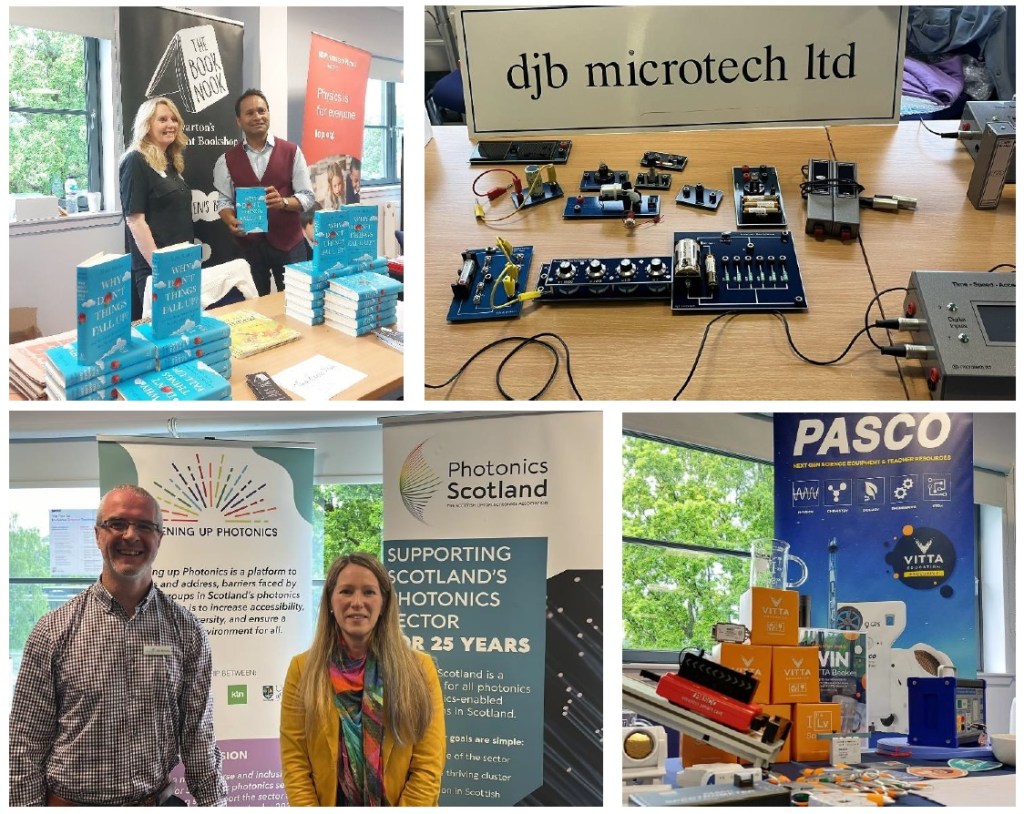
The Raising Attainment in Physics course has an added benefit compared to a conference such as the IOP Stirling Meeting. It is a multiday residential event so it provides an immersive experience away from the distractions of everyday life where participants can build relationships, some of which can extend long beyond the event itself. Participants have time to find colleagues with similar interests, face similar challenges, or who work in similar contexts which can result in longer term collaboration. However, in 2024 this residential course consisted of only two days, Friday-Saturday; one day requiring participants to be released from school and the other during their weekend. In recognition that teachers appear to be finding it increasingly difficult to be released from school this was a significant reduction from the previous four-day Wednesday to Saturday events. The same sort of variety of programme was maintained with hands-on practical workshops, sessions on pedagogy, and talks on current physics research, albeit reduced in scale. A more fun hands-on workshop was held on the single residential Friday evening, but it was clear that the amount of social interaction between the small number of participants was reduced compared to that seen previously over three evenings. It was a shame to see the experience diminished for participants, even if they might not have been aware of what they might have been missing compared to before.

I hope that the descriptions above illustrate the opportunities that attendance of subject-specific professional learning conferences offer teachers, however, it is only likely to be a stimulus and to have longer lasting impact on teachers’ practice it needs to be part of a more extensive programme of professional learning activities. This is supported by the findings of Cobb et al. (2018) in their extensive eight-year study into improving mathematics outcomes for pupils. They showed that conferences had a place in an effective provision of professional learning as they gave access to external expertise, new ideas and challenge, but that this needs to be supported by in-school subject-specific follow-up activities such as instructional coaching, collaborative planning and evaluation, and between school subject networks, all facilitated by subject experts. When I attended my first IOP Stirling Meeting in 1985 it was a treated as departmental outing by my department, as it was for many others. This allowed us to have a shared experience and to have an extended discussion in the car to and from the conference. Unfortunately, it is now relatively rare for more than one teacher from any one school to attend such events. It is therefore even more important that when teachers return to schools they are then given adequate time with colleagues to share their learning, unfortunately something that appears to be relatively rare (Farmer, 2024) with ‘cascade’ approaches often being little more than a ‘dribble’. It is important that school leaders allow for departmental and faculty professional learning as part of in-service day and collegiate time.
As Mark Logan alluded to when he spoke in parliament, he has observed some recent change at the top levels in national agencies with respect to the importance being given to computer science, and I hope this is part of a wider recognition of the importance of the role of knowledge, something highlighted by the OECD in its review of Curriculum for Excellence (OECD, 2021), and the importance subjects have in structuring this. However, there may well be lag in this change working through to other actors in the meso-level of Scottish education and thereby influencing the culture towards the importance of subjects within the curriculum, and therefore the importance of quality subject-specific professional learning in supporting improvements in the instructional core in classrooms across the length and breadth of the land.
I think it hardly needs to be said that everyone wishes to see both a closing of the attainment gap and improvements in the instructional core in classrooms with the subsequent benefits for pupil outcomes, education system performance, and for the job satisfaction and morale of teachers. This therefore raises the question, particularly as Scotland enters a period of curriculum reform, of how can we change the culture in many of Scottish schools and local authorities towards the role and impact that good-quality, well-facilitated subject-specific professional learning can bring?
In many ways I think we need to a move away from an excessive focus on externally driven scrutiny measures in schools which drive performativity rather than genuine improvement in teaching and learning. This needs to come with genuine empowerment of teachers and trust that they can use effectively any time given over to subject-specific professional learning and local subject-based curriculum-making. However, there also needs to be recognition that support and leadership will be needed from actors across the meso-level of the education system, including senior leaders in schools, to help facilitate effective collaborative, enquiry-based, subject-specific professional learning. For example, it needs more than the provision of a room for an afternoon and a flask of coffee to facilitate effective collaborative professional learning of the participants in a local authority subject network, even if the teachers are given the freedom to decide on their own priorities and agenda. Effective teacher career-long professional learning requires teacher educators with the appropriate knowledge and skills, just as the education of our children and young people requires well educated teachers.
I indicated at the start of this blog that subject-specific professional learning can meet several of Helen Timperley’s ten principles for effective professional learning, however, she also identified that there must also be opportunities to process new learning with others, multiple opportunities to learn and apply information, approaches that are responsive to learning processes, and it must be supported by active leadership which maintains momentum (Timperley, 2008). Whilst teachers themselves have a role in ensuring this occurs, these are all principles that require a good level of buy-in, support and facilitation from the leaders and decision-makers in the macro-level and meso-level of the education system if they are to occur, and this comes back to the culture in the organisations. As ever, actions speak louder than words, and from the data I have collected from teachers in recent years there is a gap between policy and practice when it comes to the professional learning of teachers in Scotland.
As the title of this blog states, it will be a pity if conferences such as those described here, largely organised by subject associations and subject-based organisations, often with significant input from volunteers, are allowed to wither due to key decision-makers within the education system not valuing the role they can play in system improvement.
I think cultures which do not sufficiently value the role of subject-specific professional learning, ones that appear to exist in much of our education system, need to change to help ensure teachers are involved in and brought along with any education reform. This will also provide teachers with the professional learning they most value and desire (Education Scotland, 2019, 2021, 2022, 2024; Farmer, 2024; Farmer & Childs, 2022). If this is not done, then these reforms will be less successful than they ought to be regardless of the policy or strategies proposed. At the end of the day, culture eats strategy for breakfast!*
*Probably not said by management theorist Peter Druker
References
Accounts Commission. (2023). Local government in Scotland: Overview 2023. http://www.audit-scotland.gov.uk/about-us/accounts-commission
Allen, B., Menzies, L., & Ford, I. (2024). The Current State of Professional Development of Teachers. https://teachertapp.co.uk/publications/the-current-state-of-professional-development-for-teachers/
Cobb, P., Jackson, K., Henrick, E., & Smith, T. M. (2018). Systems for Instructional Improvement: Creating Coherence from the Classroom to the District Office. Harvard Education Press.
Cordingley, P., Greany, T., Crisp, B., Seleznyov, S., Bradbury, M., & Perry, T. (2018). Developing Great Subject Teaching: Rapid Evidence Review of subject-specific CPD in the UK. https://wellcome.org/sites/default/files/developing-great-subject-teaching.pdf
Education Scotland. (2019). Professional Learning in STEM: Findings from the Annual STEM Practitioner Survey 2017/18 – Early learning and childcare, primary, secondary and ASN. https://education.gov.scot/media/4bklcz4l/professionallearningsurveyfindingsmay2019.pdf
Education Scotland. (2021). Professional Learning in STEM: Findings from the Annual STEM Practitioner Survey 2018/19 – Early learning and childcare, primary, secondary and ASN. https://education.gov.scot/media/g50hiodf/stem-professional-learning-survey-2018-19-findings-elc-primary-asn-and-secondary.pdf
Education Scotland. (2022). Professional Learning in STEM: Findings from the Annual STEM Practitioner Survey 2020/21 – Early learning and childcare, primary, secondary and ASN. https://education.gov.scot/media/x0oespxy/stem-professional-learning-survey-2020-21-findings-elc-primary-asn-and-secondary.pdf
Education Scotland. (2024). Professional Learning in STEM: Findings from the Annual STEM Practitioner Survey 2022/23- Early learning and childcare, primary, secondary and ASN. https://education.gov.scot/media/hq5ph4wf/stem-professional-learning-survey-2022-23-findings-elc-primary-asn-secondary.docx
Farmer, S. (2024). The alignment of policy and practice for the career-long professional learning of teachers in Scotland [University of Strathclyde]. https://stax.strath.ac.uk/concern/theses/w66344189
Farmer, S., & Childs, A. (2022). Science teachers in northern Scotland: their perceptions of opportunities for effective professional learning. Teacher Development, 26(1), 55–74. https://www.tandfonline.com/doi/full/10.1080/13664530.2021.1989481
GTCS. (2021a). The Standard for Career-Long Professional Learning: An Aspirational Professional Standard for Scotland’s Teachers. https://www.gtcs.org.uk/wp-content/uploads/2021/09/standard-for-career-long-professional-learning.pdf
GTCS. (2021b). The Standard for Full Registration: Mandatory Requirements for Registration with the General Teaching Council for Scotland. https://www.gtcs.org.uk/wp-content/uploads/2021/09/standard-for-full-registration.pdf
Institute of Physics. (n.d.). Institute of Physics – For physics • For physicists • For all. http://www.iop.org/
Logan, M. (2020). Scottish Technology Ecosystem Review. https://www.gov.scot/publications/scottish-technology-ecosystem-review/
OECD. (2021). Scotland’s Curriculum for Excellence: Into the Future, Implementing Education Policies. https://www.oecd.org/education/scotland-s-curriculum-for-excellence-bf624417-en.htm
SCILT. (2024). SCILT > Home. https://scilt.org.uk/
Scottish Government. (2023). Scotland’s National Innovation Strategy. 1–102. https://www.gov.scot/binaries/content/documents/govscot/publications/strategy-plan/2023/06/scotlands-national-innovation-strategy/documents/scotlands-national-innovation-strategy/scotlands-national-innovation-strategy/govscot%3Adocument/scotlands-national-innovation-strategy.pdf
Scottish Parliament. (2024). Education, Children and Young People Committee | Scottish Parliament TV. https://www.scottishparliament.tv/meeting/education-children-and-young-people-committee-may-29-2024
SSERC. (n.d.). SSERC. Retrieved 7 October 2023, from https://www.sserc.org.uk/
Timperley, H. (2008). Teacher Professional Learning and Development. IBE. http://www.iaoed.org/downloads/EdPractices_18.pdf
University of Strathclyde. (2024). Future directions for subject-specific professional learning for teachers: opportunities and benefits. Engage with Strathclyde. https://www.engage.strath.ac.uk/event/1044
 Stuart Physics
Leave a comment